


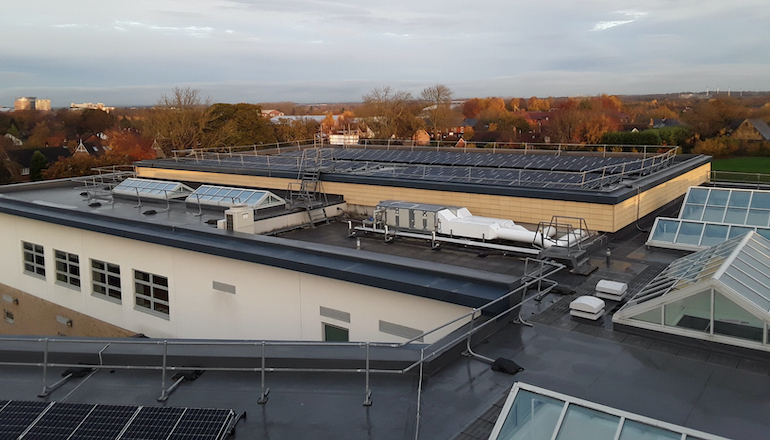
UK clean power outfit Engenera Renewables Group has completed the first of 12 projects providing renewable energy-saving solutions to schools in Newcastle Upon Tyne in north-east England.
St Mary’s Catholic School is the first to benefit from the scheme, which sees Engenera working in partnership with Robertson Facilities Management to install solar panels complemented by energy storage technology at schools across the local education authority.
The entire scheme will ultimately be managed by Aura, the Newcastle Local Education Partnership (LEP).
The project, which began in October and was commissioned in December 2021, has seen the installation 610 solar panels on the school’s roof, producing 210kW of electricity a year.
The panels are projected to give the school a cost saving of over £900,000 over a 20-year period.
Engenera has also installed energy monitoring technology in the school’s reception.
This technology aims to help the school’s pupils learn about carbon reduction and reducing greenhouse gases, as well as allowing the school’s management team to monitor its energy usage and cost savings.
The monitoring screens display the school’s energy consumption and carbon savings/footprint in real time, allowing children to take an active interest in the carbon footprint of their place of education.
It is also hoped that teachers at all the schools involved in the Newcastle scheme – across a multitude of disciplines within the curriculum – can use the information taken from the monitoring technology to incorporate carbon reduction and renewable energy education into their lessons, Engenera said.
Engenera chief executive Bryan Glendinning said: “It’s incredibly satisfying to be involved in this project – the first in an extensive scheme to bring cost savings, carbon reduction, and education about renewable energy to 12 schools across the Newcastle Local Education Authority.
“It is amazing to be able to use our skills and technology to help these schools reduce their bills and carbon footprint, but it is even better to be able to also invest in grassroots education in this way and help inform and educate a new generation of children about the reality of energy generation and how technology can help make things better.”