


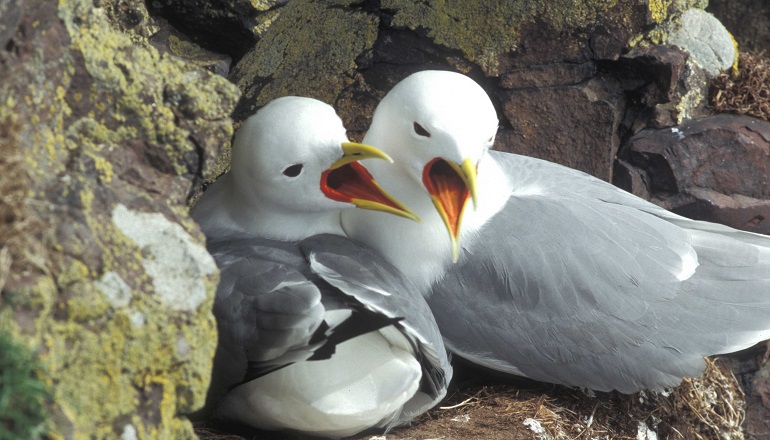
Vattenfall is funding a feasibility study to better understand how Black-legged Kittiwake populations will respond to potential mortality induced by offshore wind farms.
The project, to be delivered by JNCC, was identified as a priority by the Offshore Wind Strategic Monitoring and Research Forum (OWSMRF) Pilot Year, which is an industry-led collaborative partnership developing research on the effects of offshore wind development on marine birds.
Kittiwakes are a long-lived species, spending most of their time foraging at sea and nesting on steep coastal cliffs.
This means that acquiring sufficient knowledge on how their colonies and populations are faring can be challenging, JNCC said.
Poor understanding of the life of individuals is limiting our ability to predict how resilient kittiwake populations might be to any additional mortality caused by offshore wind farms.
JNCC marine species team leader Helen Baker said: “This is an exciting project, that would not have been possible without the positive collaboration between industry, government advisers and academic partners through OWSMRF.
“It’s great to see Vattenfall fund the research and we are delighted to help them secure high quality, independent science. We hope that other research projects identified by OWSMRF will be taken forwards by industry in future.”
Following individual birds throughout their life cycle using a conspicuous marking system helps record information of where kittiwakes nest, what colonies they visit during the breeding season, and whether they have survived or not from one year to the next.
Colour-ringing, which is safe for the birds, offers a useful approach to address these questions: birds are equipped with a rigid colour ring that has a unique combination of letters and numbers and can be viewed at a distance with binoculars or a telescope, enabling that bird to be identified without recapturing it.
JNCC project manager Lise Ruffino said: “While colour-ringing is commonly used in the UK and elsewhere to learn about kittiwake biology and movements, it remains unknown how much ringing and re-sighting effort needs to be deployed at the breeding colonies in order to obtain robust demographic information on UK kittiwake populations.
“This project will specifically address these questions by bringing in the best knowledge and expertise in the field.”
Vattenfall project manager Jesper Kyed Larsen added: “A solid and up to date understanding of how kittiwake populations work is crucial to assessing the potential impacts of offshore wind development.
“It is our hope this study can help pave the way for a better evidence base for decision making to the benefit of both offshore wind development and kittiwakes.”