


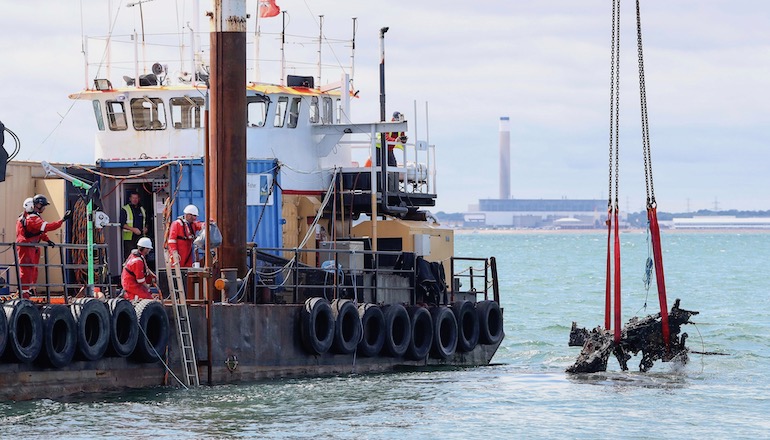
A World War 2 aircraft is being raised from the seabed as part of work on the IFA2 interconnector between England and France.
Specialist divers and archaeologists are retrieving the wreckage of the 1943 Fairey Barracuda torpedo bomber.
The three-seater plane, part of 810 Squadron Royal Navy Air Station, based at Lee-On-Solent is believed to have got into difficulty shortly after taking off for its test flight before crashing 500 metres from the coast in Portsmouth.
It was found by National Grid engineers last summer during a seabed survey ahead of the construction of the subsea electricity cable between England and France.
The cable will stretch for 240km between Fareham, Portsmouth and Normandy, France and deliver cleaner, cheaper and more secure energy for UK consumers.
The Barracuda wreckage is the only one to have ever been found in one piece and the last remaining aircraft of its kind in the UK.
National Grid IFA2 head David Luetchford said: “Interconnectors are about bringing us closer to a zero-carbon future, but we must also respect the past.
“An important part of our job is to always have a thorough and sympathetic approach to archaeological finds.
“Over the course of the project we’ve inspected over 1000 targets of interest, many of which were found to be unexploded ordnance, not unusual given the history of this location.
“However, to have found a 1943 Fairey Barracuda torpedo bomber is incredible and such a key piece of British history.
“It’s not every day you get the chance to play a role in an operation like this and it is very lucky to have found the plane in such a small search area.
“We surveyed a 180-metre-wide area along the cable route and if we had chosen a slightly different route, there is a good chance the plane would never have been found.”
Work to fully retrieve the plane is expected to take about three weeks as experts from Wessex Archaeology carefully excavating the area around the aircraft to remove large amounts of silt and clay.
So far, one of the wings has successfully been lifted out of the waters and work on the second is currently underway.
Wessex Archaeology lead archaeologist Euan McNeil said: “Our team has been working closely with all those involved to ensure that any risks to heritage assets on the seafloor are mitigated.
“This aircraft is a rare find and a fantastic opportunity to understand more about a piece of wartime technology.
“We have been undertaking the excavation under a licence from the MoD, and it has taken careful planning to ensure that we lift the remains and any associated material which may have been scattered as it sank – without causing its condition to deteriorate significantly.
“This has involved excavating the silt around the plane and sieving it for artefacts, then carefully dividing the remaining structure into manageable sections for lifting.
“The recovery of the Fairey Barracuda will aid an ongoing Fleet Air Arm Museum project to recreate what will be the world’s only complete example of this type of aircraft.
“This will give us a chance to examine a unique lost piece of aviation history.”
Once retrieved, the parts will be taken to the Royal Navy Fleet Air Arm museum in Somerset, where it will be studied and used to rebuild a full-size Barracuda in the site’s aircraft hangar.
Museum curator David Morris said: “This is an incredible find and a wonderful piece of British history.
“There are very few blueprints of the Barracuda plane design available so this wreckage will be studied to enable us to see how the plane segments fitted together and how we can use some of the parts we currently have.
“This find is a huge step forward for our project and we can’t wait to get it back to the museum and share our findings with the public.”
IFA2 is the National Grid’s second electricity subsea interconnector to France and is a joint venture with French System Operator RTE.