


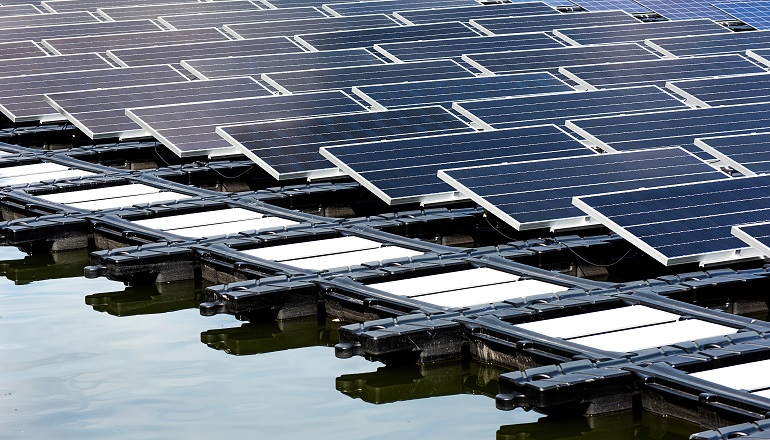
Energy companies, including Equinor and EDF, are part of an industry collaboration launched by DNV GL to develop the first recommended practice for floating solar power projects.
The planned recommended practice will provide a commonly recognised standard based on a list of technical requirements for developing safe, reliable and sustainable floating solar projects, DNV GL said.
The Floating Solar joint industry project also includes BayWa RE, Blue C Engineering, Carpi Tech/Makor Energy, Ciel & Terre International, Compagnie Nationale du Rhone, Noria Energy, EDP, Isigenere, Mainstream Renewable Power, Scatec Solar, Seaflex and Statkraft.
Up to 4TW of floating solar is estimated to be possible globally the consortium said, but there are as yet no harmonised standard approaches to developing the technology.
“This makes it difficult for investors, regulators and other stakeholders to have confidence in planned projects and to enforce relevant requirements, which could potentially put a break on the technology’s growth,” DNV GL said.
The project will look at all aspects of developing floating solar projects on inland and inshore waters.
It will focus on five key topics site conditions assessment, energy yield forecast, mooring and anchoring systems, floating structures, permitting and environmental impact.
The consortium aims to define requirements and guidelines that can be applied in practical manner to all floating solar projects, DNV GL said.
A draft guideline document should be completed by the end of 2020.
This will be made available for widespread industry consultation before the publication of the verified recommended practice, currently scheduled for the first quarter of 2021.
BayWa RE project manager Toni Weigl said: “As currently being the largest floating PV developer in Europe, BayWa RE is happy to be part of this consortium to develop this important guideline for the floating PV industry.
“We think establishing uniform high standards for floating PV power plants will help to mature and enhance the floating PV industry, therefore we are excited to bring in our extensive knowledge from the successfully realised floating PV projects.”
DNV GL energy business in Northern Europe, Middle East and Africa executive vice president Prajeev Rasiah said: “Floating solar is a rapidly expanding technology with huge potential to help nations decarbonise, and one that we have been intimately involved with for many years.
“Drawing on our expertise in solar energy, floating wind, offshore platforms, oil and gas and maritime technologies and industry knowledge, we have directly contributed to more than 1GW of floating solar projects, at different development stages.
“We are excited to work with so many committed industry leaders to create a recommended practice that will provide clear guidelines and requirements for safe, performing and long-lived floating solar projects.”