


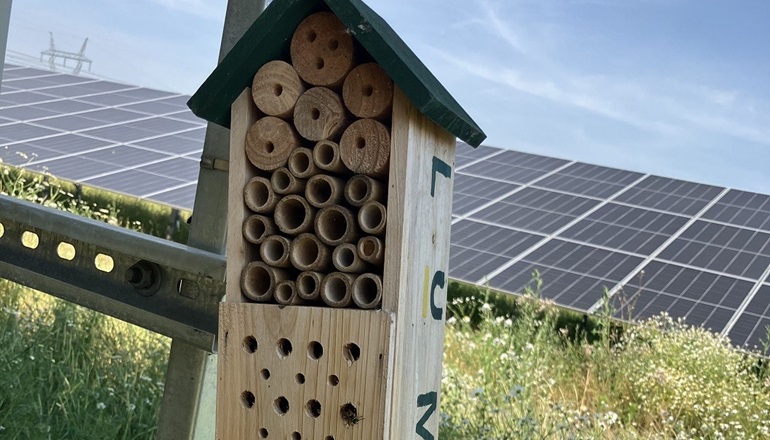
SolServices has report a significant boost in biodiversity at a 138MW solar farm in Hungary.
Lumen Park Szolnok is the “first nature-friendly solar park not only in Hungary but also globally”, implemented using modern sustainable methods, plant and animal-friendly approaches and revitalisation of soil depleted by decades of agricultural use.
The company has opened its professional database for academic research, resulting in the first scientific paper based on this data.
The results show that in 2023, the number of plant species increased significantly compared to the initial state and the total coverage of regenerating vegetation is also substantial.
The coverage of valuable species has increased, and the Shannon diversity index has also improved in the areas.
Bird diversity also increased post-construction compared to the baseline and control area surveys, partly due to the solar park’s function as a feeding ground compared to large-scale agricultural habitats.
Certain species like the Eurasian skylark (Alauda arvensis) and corn bunting (Emberiza calandra) have started nesting in fewer numbers, while others like the Eurasian stonechat (Saxicola rubicola) showed no population change.
New nesting species such as the common pheasant (Phasianus colchicus), crested lark (Galerida cristata), and others have appeared in the solar park.
The total bird population observed in 2023 included 23 species and 697 individuals, with new area-using species like the bluethroat, lesser grey shrike, tree pipit and common linnet.
The survey also highlighted that the nesting success of eastern imperial eagle and saker falcon was not affected by the solar park, while the occurrence of the common buzzard and kestrel increased significantly.
The area, previously used for large-scale agriculture, now features a near-natural habitat, indicating the spontaneous formation of natural plant cover.
Rare plants like the sea arrowgrass (Triglochin maritimum) and the protected saltmarsh buttercup (Ranunculus lateriflorus) have appeared.
To combat the significant coverage of agricultural weeds and invasive species, a special seed mix was sown in 2023 to promote further natural habitat formation, increasing species richness and diversity while naturally suppressing undesirable and invasive species.
The creation of nature-friendly solar parks must follow well-established principles and practices and so SolServices has developed a detailed professional guide in collaboration with experts and organisations, enabling other solar park developers to establish nature-friendly solar parks.
“It’s important to emphasise that we’ve achieved all this with a highly diverse team of different professional backgrounds and nationalities, always aiming for concrete solutions and actual implementation, staying a step ahead of the market,” said SolServices chief executive Gabor Farkas when presenting the first-year research results of the ecological survey.