Glasgow-based consultancy Neo Environmental has developed an in-house service for assessing glint and glare effects from solar panels on residences, airfields and transport routes.
The newly-developed model tracks the location of the sun as it passes through the sky for every minute of a typical year.
Using 3D reflection vector calculations, Neo can anticipate the exact times and impacts of solar reflections on a variety of different receptor types.
The company will conduct a free initial assessment of the site and recommend the level of assessment which may be required.
The assessment has been specifically developed for the UK and Irish markets, however the model can be used to assess glint and glare effects worldwide.
Neo said the assessments are generally being requested for ground mounted solar projects, but are equally as effective when considering impacts from roof mounted projects.
Neo director Michael McGhee said: “We are the only Scottish company to have such capabilities and have already been inundated with requests for this service from Ireland, England, Wales and Scotland. There are only a handful of companies with such capabilities in the UK.”
Although solar panels are designed to absorb as much light as possible and not to reflect it, glint can be produced as a direct reflection of the sun from the surface of the solar PV panel, and can be described as a momentary flash.
Glare is significantly less intense in comparison to glint and can be described as a continuous source of bright light, relative to diffused light. Glint and glare may be an issue due to visual impact, viewer distraction or for aviation.
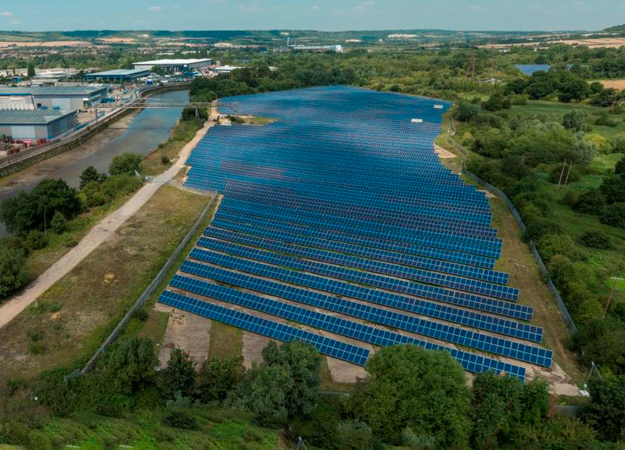
Image: solar PV farm (Foresight)
Neo squints at glare and glint
Scottish company develops programme to asses solar glare effects
 By EBS