


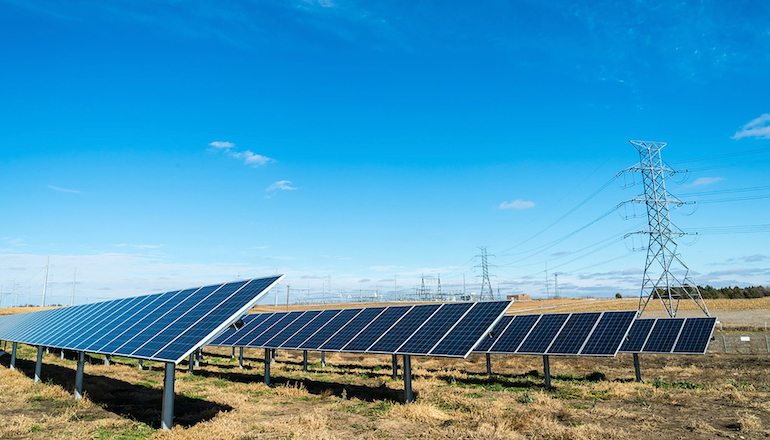
Solar photovoltaics dominated as the main new power generation capacity added around the world last year, with a record 118GW constructed, according to Bloomberg New Energy Finance (BNEF).
BNEF’s new Power Transition Trends 2020 report found PV topped all other technologies in new-build terms with a record 118GW constructed, in dozens of countries including Australia, India, Italy, Namibia, Uruguay and the US.
The technology was the most popular technology deployed in a third of nations, said BNEF, representing 45% of new generation capacity added in 2019.
In all, 81 countries built at least 1MW of solar during the last calendar year.
The report highlighted that solar PV has grown from 43.7GW of total global capacity installed in 2010 to 651GW as of year-end 2019.
Wind and solar accounted for over two-thirds of the 265GW of new capacity installed worldwide in 2019, up from less than a quarter of new build in 2010.
For the first time, the two technologies also accounted for the majority of new generation recorded in 2019. Including hydro power, renewables made up three-fourths of 2019 commissioned capacity.
Solar in 2019 also moved past wind (644GW) to become the fourth largest source of power on a capacity basis, behind coal (2089GW), gas (1812GW), and hydro (1160GW).
There is now more wind and solar capacity online worldwide than total capacity from all technologies, clean or dirty, in the US.
BNEF analyst Luiza Demoro said: “Sharp declines in solar equipment costs, namely the modules that go on rooftops and in fields, have made this technology widely available for homes, businesses and grids.
“PV is now truly ubiquitous and a worldwide phenomenon.”
On a generation basis, solar’s contributions are “considerably less” due to PV’s lower capacity factors compared to fossil fuels.
In 2019, solar accounted for 2.7% of electricity generated worldwide, BNEF found, up from 0.16% a decade ago.
BNEF expects the market to continue to grow, with 140-178GW of new solar to be built in 2022, given the inexpensive nature of the technology and the limited penetration on a generation basis.
From 2018 to 2019, power produced from coal dropped 3% as plants ran less frequently. This marked the first fall in coal generation since 2014-2015 and while the world has far more coal plants online today than a decade ago, those plants are running less often, BNEF found.
“Wealthier countries are moving quickly to mothball older, largely inefficient coal plants because they can’t compete with new gas or renewables projects,” said Ethan Zindler, head of Americas at BNEF.
He added: “However, in less developed nations, particularly in south and southeast Asia, new, more efficient coal plants continue to come on line – often with financial support from Chinese and Japanese lenders.”