


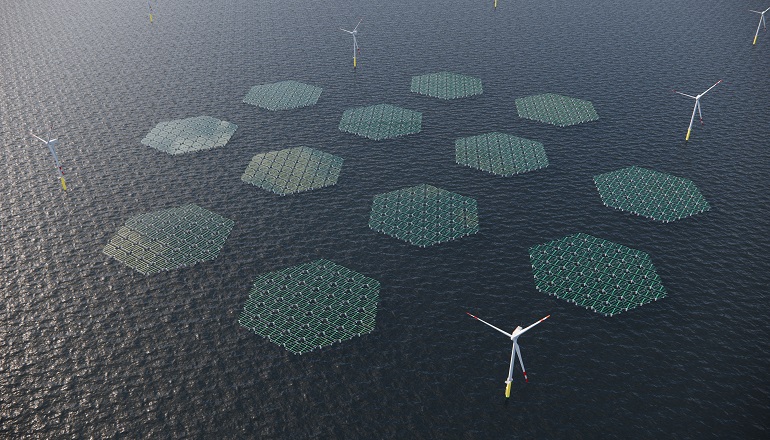
RWE and the Dutch-Norwegian company SolarDuck have signed a cooperation agreement to jointly advance the development of floating solar parks at sea.
In order to gain “fundamental insights” into SolarDuck’s floating solar technology, RWE will invest in a pilot project in the North Sea.
The Merganser pilot will have a rated output of 500kW and will go live in 2023.
Merganser is to be installed off the coast of Ostend in the Belgian North Sea and will be SolarDuck’s first offshore pilot project, following the successful commissioning of a pilot project in the Netherlands last year.
The project is a first step in the cooperation and lays the foundation for a larger demonstration plant off the Dutch coast.
RWE is applying for sites for offshore wind projects as part of the Dutch Government’s Hollandse Kust West (HKW) tender and has included SolarDuck in its bid with an innovative combination of floating offshore solar systems and integrated storage solutions.
The floating offshore solar technology developed by SolarDuck allows a more efficient use of the marine space for energy generation by using the space between the wind turbines as well as “synergies” in the construction and maintenance of the turbines.
Due to the complementary availability of wind and solar resources, a more balanced production profile also results.
SolarDuck’s unique, triangular platform design has received the world’s first certification for floating offshore solar installations from Bureau Veritas.
The platform is designed to float several metres above the water and follow the waves, comparable to a carpet.
In this way, important electrical components remain dry, clean and stable to help ensure the longevity of the semi-submersible structure, while at the same time ensuring safe operation and maintenance.
Sven Utermöhlen, CEO Wind Offshore at RWE Renewables, said: “With the SolarDuck pilot project, we are gaining experience with an innovative concept.
“We want to contribute to accelerating the energy transition, positively influencing marine ecology and promoting the integration of energy systems.”