


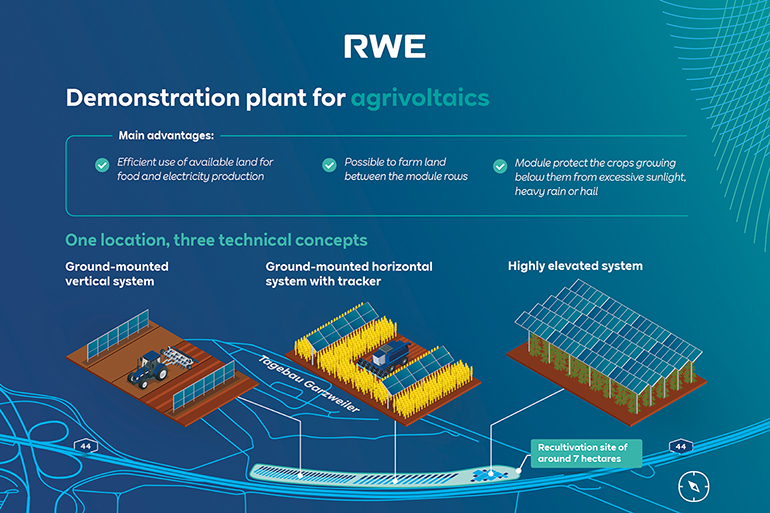
RWE has unveiled an Agri-PV demonstration project in Germany.
The plant is on the edge of the Garzweiler opencast lignite mine on a recultivation area of around seven hectares, in which solar power is to be generated and arable and horticultural is to be carried out at the same time.
The research project is funded by the state of North Rhine-Westphalia through the progres.nrw program for climate protection and energy transition.
The demonstration project will have a capacity of 3.2MWp (equivalent to about 2.5MWac) and is scheduled to go into operation by the end of the year.
The research activities, which will run for at least five years, are scheduled to start at the beginning of 2024.
The aim is to test suitable management methods and value-adding operator concepts for Agri-PV systems.
To this end, Forschungszentrum Jülich contributes its scientific expertise in the combination of plant research and photovoltaics – also in the context of the bioeconomy.
In addition to recultivation areas, RWE has long-standing relationships with regional agriculture and extensive technical know-how from the planning, construction and operation of solar plants worldwide.
Three different Agri-PV concepts are planned for the demonstration plant, which will enable both arable and horticultural use of the area.
In the first system from Next2Sun, the solar modules are to be mounted firmly and vertically on the stud structure.
There is sufficient space for harvesting machines between the rows of modules, so that agricultural use can also be tested.
In the Schletter system, the modules are also arranged in rows, but are mounted on a movable axis and follow the course of the sun from east to west.
This is intended to optimize the yield of the PV system and at the same time make land available for agriculture.
In the third system from Zimmermann PV-Stahlbau, the PV modules are mounted on a pergola-like substructure. Special crops such as raspberries or blueberries could grow among them.
Chief executive for RWE Renewables Europe & Australia Katja Wünschel said: “Soils are a scarce resource that we use responsibly and efficiently.
“Given the large number of areas required for the expansion of solar energy, synergies such as those of agri-PV are very valuable.
“A double harvest can be reaped here – namely solar power and agricultural yield.
“With our demonstration plant in Bedburg, we are conducting important application research in order to be able to exploit the full potential of this technology in the future.
“In doing so, we concentrate on suitable crops, the optimal design of the associated PV systems and the cooperation concepts with the farmers.”