


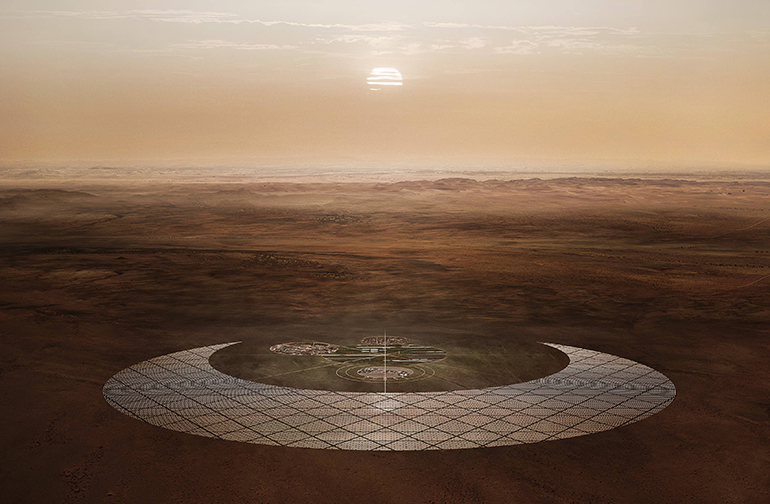
GreenGo Energy has filed an application to Mauritania’s Ministry of Petroleum, Energy and Mines in Mauritania for the development of the 60GW Megaton Moon green energy park.
The project is planned for a staged implementation process closing the circular architecture to reach 60GW/190TWh of hybrid solar and wind generation and 35GW of electrolysis producing 4m tonnes of green hydrogen yearly or further processed 18m tonnes of green ammonia.
The phased development targets COD of first pilot stage by 2028 and last stage by 2033-2035.
“The climate crisis is real. We need action immediately to reach Paris commitments and NetZero,” said GreenGo Energy chief executive Karsten Nielsen.
“But we also need action at scale and with impact! Megaton Moon embodies climate action with an ambition to deliver 1% of the total global green hydrogen demand by 2050 to reach net zero.
“We only need 100 projects at this scale completed and distributing green fuels globally by 2050. This is doable.”
Last week a delegation from the Danish developer met with a delegation from Mauritania’s Energy Ministry under Minister of Petroleum, Energy and Mines, HE Nani O Chrougha, to discuss the project application and value proposition.
The Ministry expressed appreciation and sincere interest in the Megaton Moon project and presented the mature status on drafting of the green hydrogen law with expectations for approval first quarter of 2024.
“Mauritania is ideally positioned to become one of the future world green hydrogen production hubs for a range of strong reasons,” said Nielsen.
“Mauritania holds some of the best solar and wind resource cross in the world, large areas of suitable flat land and coastal proximity for water and shipping.
“Green hydrogen production cost is half of Northern Europe, potentially lower. Furthermore, the region has some of the most operator-friendly fiscal policies on the continent, as documented by a history of significant oil and gas investments by world energy majors. Proximity to load centers in EU is an additional benefit. “
The project will utilize the 10TWh-plusof surplus power to facilitate development of a large scale, local desert farming industry, establish a new green industry including local supply chain attracted by the new paradigm of abundant low-cost green energy and water.
More than 70 million tons of desalinated water will be generated yearly to facilitate this development, or triple of what is consumed in the Megaton facility itself for green fuel production.
GreenGo’s vision is to transform the capital Nouakchott and the country by sparking significant socioeconomic, green industrial and urban development. It also aims to introduce a permanent and 100% sustainable solution for the crucial water, power and energy scarcity that has historically been a constant for Nouakchott and Mauritania in general.
“Implementing significant scale to improve both project economics and at the same time enable transformative development for a country or region embodies our purpose as a company. Megaton Moon will help millions of people,” said Nielsen.
Project development is in progress said GreenGo, fully leveraging the development platform at the company in Denmark, benefitting from experience gathered from the further progressed 4GW sister site in Ringkobing-Skjern, Denmark.
The scheme’s engineering and development partners are COWI on PtX and infrastructure design, and New Power Partners supports renewable energy engineering design as an extended arm to GreenGo Energy’s global development, design and engineering team.
“Developing a project of this magnitude requires close cooperation with the supply chain and the offtake partners,” said head of global Megaton development Anders Heine Jensen.
“To ensure that the supply chain is in place the Megaton project will be implemented in three main stages each comprising five to ten building blocks.
“In addition, the projects size is set to attract the establishment of local production of PV panels, wind turbine blades and electrolysis components on which we are currently negotiating MoU’s with manufactures.
“Provided that the project is approved in due time the first hydrogen and ammonia can be produced by 2028 while the full facility can be in place by 2033.”
The scheme will be financed through GreenGo Energy’s entrenched partnership approach with Tier1 investors in the green energy space, where the company will deliver the project through its 360-degree full services platform, leveraging a long track record of project delivery.