


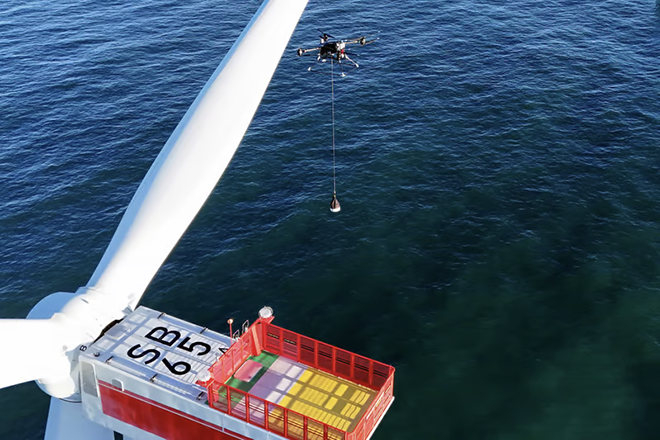
Vattenfall is combining artificial intelligence with drones to support its offshore wind activities.
Thanks to advanced sensors and AI-powered software, cargo drones can fly safely in complex offshore environments, avoid obstacles and adapt to changing weather conditions.
They can transport materials and equipment from a service operation vessel to wind turbines, reducing the need for vessels to go back and forth.
The use of an unmanned air vessel (UAV) speeds up the delivery of materials, saves time, and reduces CO2 emissions by eliminating the need for a crew transfer vessel.
This innovation was recently tested in Vattenfall’s offshore wind farms DanTysk and Sandbank in the German North Sea.
A collaboration between offshore service provider Ampelmann, Dutch Applied Scientific Research Institute TNO, and Vattenfall demonstrated the use of cargo drones in the offshore environment.
Roddy Douglas, automation engineer at Vattenfall Offshore Wind in the UK, was involved in the test.
He said: “The innovation we showcased included using UAVs for rapid deliveries and pre-loading spare parts and tools to the turbine’s nacelle.
“This is especially beneficial when a part is needed unexpectedly, allowing the on-site team to work efficiently, without waiting for a ship, minimising downtime and revenue loss at wind turbine generators.
“For sites closer to the coast, cargo can be transported directly from the service centre, where operators use automated drones to deliver essential cargo even in challenging weather conditions.”
Aerial drones are used in Vattenfall’s offshore activities for the inspection of wind turbine blades and are being tested for spare part delivery, while unmanned vessels are used for seabed surveys and for the inspection of foundations below the water level.
Some drones are piloted by a nearby pilot, while others are piloted by a remote-control centre, which can even be located in another country.