


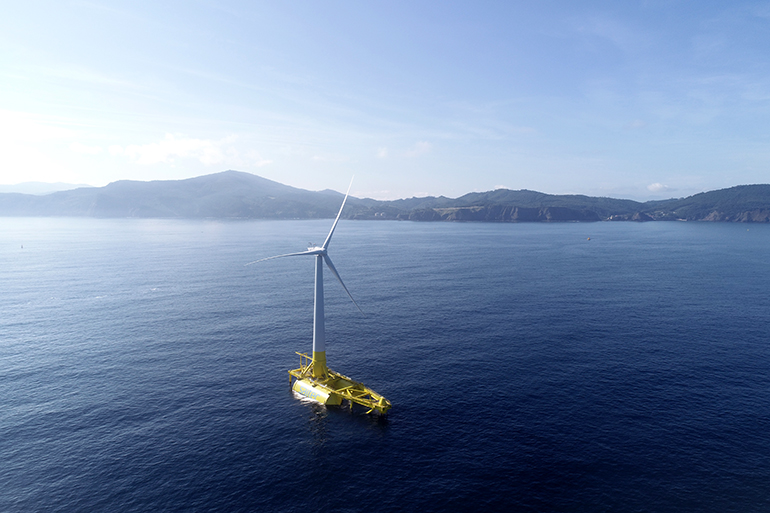
RWE and Saitec have announced they will collaborate to commission enhanced environmental monitoring studies at the 2MW DemoSATH floating offshore wind project off the coast of Spain with a new DemoSATH Lab initiative.
The demonstrator turbine has been operational off the Basque coast since September 2023 and is providing first-hand insights into the challenges of operating floating hardware on the open sea.
Spanish engineering firm Saitec Offshore Technologies and German developer RWE’s DemoSATH Lab initiative will provide further environmental monitoring studies around the project.
The research will study the platform’s interactions with the environment focusing on the possible impact on birds, the emission of underwater noise and the interactions of marine life with the structure.
The programme will last until at least the end of 2025 in order to span multiple seasons and weather conditions, said the partners.
“The knowledge acquired, based on the experience in DemoSATH Lab will allow Saitec Group to improve the ecological fit of SATH technology and develop floating offshore wind projects respectful to the marine environment,” said head of environment and stakeholder engagement at Saitec Javier Del Real.
The study will use data from the DTBird monitoring system already installed at the DemoSATH platform. Its dual aims are to increase understanding of the interactions of birds with floating offshore turbines and foundations and to improve avian detection module algorithms and responses.
An underwater noise monitoring system has also been set up for the operational phase of the project.
The outputs will be analysed in comparison to the baseline underwater noise profiles measured before the demonstrator was installed and during commissioning.
This will increase understanding of operational underwater noise from floating wind installations and the overall impact on the noise landscape through the project lifetime.
Additional information about the presence and behaviour of marine mammals around the structure may also be obtained.
A Remotely Operated Vehicle will be deployed periodically to observe how marine life such as invertebrates, fish and marine megafauna interact with the DemoSATH substructure, moorings, anchors and power cables. These monitoring activities will provide insights into the presence, abundance and behaviour of fauna groups/species around the floating offshore wind turbine.
Director of floating wind at RWE Offshore Wind GmbH Martin Dörnhöfer added: “As a leading global offshore wind player, we are also pioneering in floating offshore wind.
“Through the DemoSATH project, we are gaining first-hand experience in the deployment and operations of floating offshore wind technology on the open sea.
“The DemoSATH Lab research will help us to increase our understanding of key biodiversity aspects of floating offshore wind turbines, such as underwater noise and bird interactions during operation.
“This will help us to ensure our future development of floating offshore wind is undertaken in coexistence with nature.”