


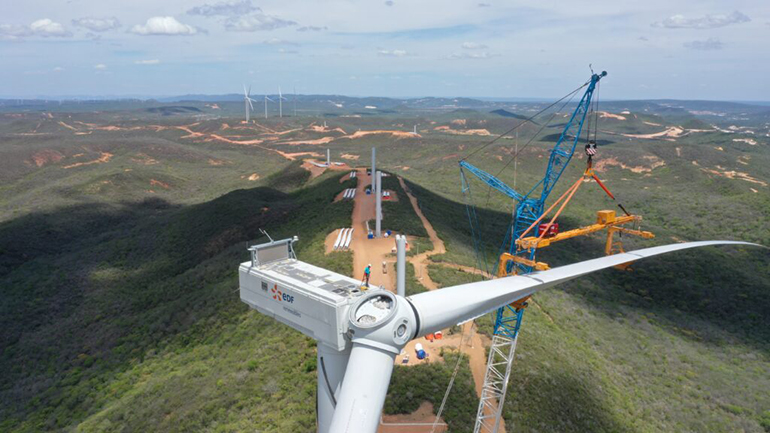
EDF Renewables has commissioned its largest wind farm in South America, the 480MW Serra do Seridó array in Brazil.
The site comprises 85 wind turbines in the state of Paraíba in the north-east of the country and will produce the equivalent of the annual electricity consumption of about 1.5m Brazilian households.
EDF said the commissioning of Serra do Seridó confirms its long-term commitment to the country and illustrates its contribution to the energy transition thanks to its expertise in a wide range of complementary technologies.
The project holds a tariff for part of the electricity produced, after winning an auction organised by the Brazilian federal government launched in 2019. Another portion of the electricity was sold on the market under pluriannual power purchase agreements.
The construction of the park was carried out in two phases and started in 2021.
The work mobilised nearly 2000 people, including 30% of local employment. As part of its commitment to supporting local communities, EDF Renewables said it has conducted various socio-economic development activities, including training for farmers on the restoration of degraded rural areas, in partnership with the Paraiban state company.
The EDF Group has been present in Brazil for nearly 30 years and has a total of 1.8GW of wind and solar projects in the country and operates the 402MW Sinop hydroelectric power plant, as well as the 827MW Norte Fluminense and 565MW Marlim Azul CCGT power plants.
Recently, the group has won a first project in the electricity transmission sector and is also developing storage solutions.
“The inauguration of the Serra do Seridó wind farm is an important milestone that demonstrates our ongoing commitment to a carbon-neutral future, also contributing to the decarbonization strategy of our clients,” said EDF Group senior executive vice president in charge of the international division and chairman of EDF Renewables Béatrice Buffon.
“By providing sustainable energy, we contribute to the fight against climate change and promote socio-economic progress for local communities around our facilities, a crucial challenge to foster a just and sustainable energy transition.”