


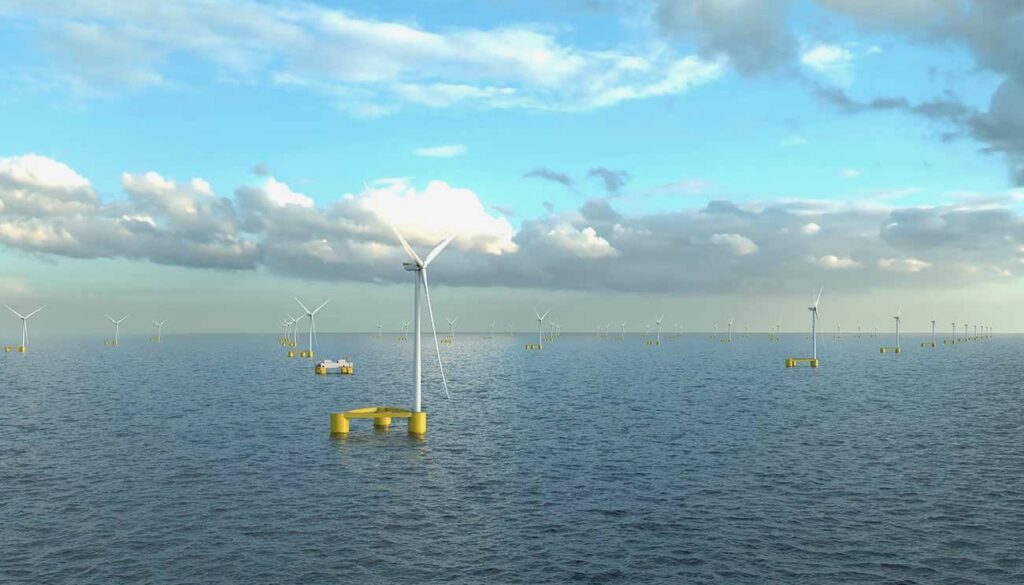
Equinor’s Bandibuli floating offshore wind project off the coast of Ulsan, South Korea, has received approval of its Environmental Impact Assessment (EIA).
Achieving this milestone allows the Bandibuli project (pictured) to participate in the fixed-price contract auction for wind power projects.
Since the Bandibuli project obtained the electric business license in November 2021, it has conducted an extensive EIA for around two years, starting in December 2021.
This period is approximately twice the standard one-year survey period typically conduced in the industry, Equinor said.
Monthly surveys and assessments were performed, covering studies of marine mammals, seabird, marine water quality, sediment quality, marine physics, air quality, land use, noise & vibration, terrain & geology, and socio-economic impact.
The process involved consultations with local and international experts alongside reviews by specialised institutions, leading to the successful completion of the EIA, it added.
Bjørn Inge Braathen, country managing director of Equinor Korea, stated: “The Environmental Impact Assessment for the Bandibuli project was conducted through close cooperation with local fishermen and residents, adhering to both domestic EIA and international ESIA standards set by the International Finance Corporation.
“The participation of local fishermen’s vessels as support ships ensured the safe and successful completion of the EIA.
“We are grateful to the Ulsan local fishermen for their important support in this process.”
Torgeir Nakken, project director for the Bandibuli Floating Offshore Wind Project, added: “With the successful completion of the EIA, the Bandibuli project is now eligible to participate in the Korean fixed price contract auction for wind power projects later this year.
“It is an important milestone towards the industrialisation of floating offshore wind.
“Equinor established the concept of floating offshore wind technology with the installation of Hywind Demo in 2009.
“Since then, Equinor has led the development of floating offshore wind technology, including the construction of Hywind Scotland, the world’s first floating offshore wind farm in 2017 and the launch of Hywind Tampen, the world’s largest floating offshore wind farm in 2023.
“By leveraging this experience together with Korea’s world class supply chain we believe Bandibuli will be the next step in the development of floating offshore wind.”