


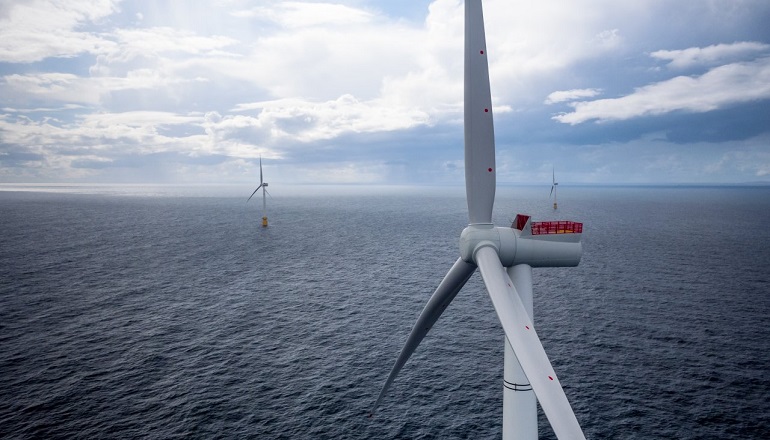
Equinor’s 30MW Hywind Scotland floating wind farm has passed five years in operation since its commissioning in 2017.
The project, located off the coast of Peterhead, is the world’s first floating offshore wind farm and has achieved a capacity factor of 54% with no loss time injuries during its operation.
It features five turbines and utilises the Hywind floating spar-substructure concept as well as Equinor’s proprietary floating wind turbine motion controller which improves capacity factor performance despite the added motion experienced by floating offshore wind substructures.
Hywind Scotland generates enough electricity to power the equivalent of 34,000 UK homes.
Equinor said it has been advancing environmental initiatives at the Hywind Scotland project and is collaborating with Marine Scotland to better understand how fishers can safely operate around and within floating offshore wind farms.
Further initiatives include the installation of an autonomous SailBuoy to map fish presence and biomass quantity with acoustic sensors and testing a new method of analysing environmental DNA (eDNA) at Hywind Scotland.
Equinor has implemented a unique operations and maintenance model to maintain the wind farm which involves upskilling onshore wind technicians to maintain turbines in an offshore, floating environment.
The Norwegian developer’s next floating wind project, the 88MW Hywind Tampen, delivered first power earlier this fall and will be fully operational in 2023.
Equinor plant manager of Hywind Scotland William Munn said: “Operating the Hywind Scotland project for the past five years has informed Equinor of some of the unique challenges associated with a floating wind farm, and the rewards if we get it right.
“Because of its location and the harsh weather conditions it encounters, Hywind Scotland has exposure to higher wind speeds than we typically see on a fixed-bottom wind farm, but also has to withstand large waves, while continuing to produce power with wave heights of 10 metres.
“Due to the environment, unique operations and maintenance methods have been required, such as a high-performance crew transfer vessel (CTV) that can continue operations in higher-than-standard transfer conditions.”
Equinor head of floating wind Steinar Berge said: “Equinor is the world’s most experienced operator and developer of floating wind and is taking lessons learned from Hywind Scotland further towards global opportunities.
“We are advancing plans to develop additional projects, including in South Korea, Australia, France, Spain, California, the UK’s Celtic Sea and Norway.
“Hywind Scotland provides Equinor with strong confidence in floating offshore wind technology and enables us to advance even-larger projects with a solid operational foundation, getting us closer to the ultimate aim of industrialising and commercialising floating wind.”