


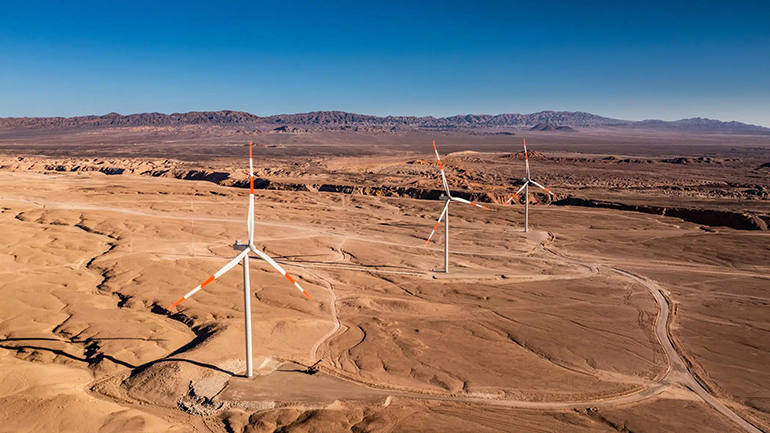
South America’s cumulative onshore wind capacity will double to 79GW in the next 10 years as developers install 40GW of new capacity by 2033, according to Wood Mackenzie.
Last year was a record year with 5.9GW of onshore wind additions in South America, helped by a rush in Brazil to secure expiring wheeling fee subsidies, stated the analyst’s latest South America onshore wind power outlook.
Despite limited power demand visibility, Brazil maintains its lead as largest market in the region.
The country alone will contribute 54% of the total regional growth, adding 21.5GW by 2033, followed by Chile (6.2GW) and Argentina (4.5GW), with all three countries expected to leverage commercial and industrial PPAs to underpin wind development.
“As the recent policy-driven renewables overbuild slows in the top two markets, Brazil and Chile, South America will face limited growth in the medium term,” said senior research analyst, power & renewables at Wood Mackenzie Karys Prado.
She added: “Going forward, market recovery will rely on grid upgrades that help overcome solar competition, as well as power demand boosts, such as green hydrogen opportunities.”
According to the report, limited transmission infrastructure will remain a challenge for onshore wind in the region, facing fierce competition with cheap solar which benefits from dispersed locations to overcome essential grid upgrades still pending completion.
“One of the critical drivers for the region is the free market,” Prado said.
She added: “Large offtakers pursuing decarbonisation goals and negotiable contracting conditions will remain essential for onshore wind expansion as markets mature in Argentina, Brazil, Chile and Peru.
“Colombia and Ecuador will still depend on the regulated market and its centralised auctions to underpin development.
“With state utilities in Bolivia, Guyana and Uruguay also expected to continue playing a crucial role in promoting onshore wind projects.
“Overall, a clear supply and demand policy is essential to unlocking the upside in South America, from power mix diversification to green hydrogen.”