


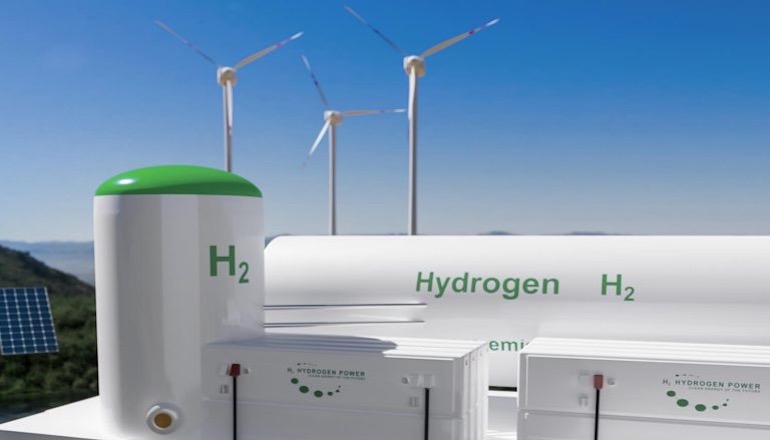
RenewableUK has published a new guide which aims to explain to investors and policy makers how the government’s Hydrogen Production Business Model works.
Demystifying the Hydrogen Business Model for Electrolysis also addresses the challenges which come with it and the reforms necessary to ensure the UK can rapidly deploy the first tranche of major green hydrogen projects needed to catalyse cost reduction.
The UK government has set a target of 10GW of low carbon hydrogen by 2030, half of which will be green hydrogen generated from renewables.
Analysis shows this will support over 12,000 jobs and attract £11bn in private investment, according to RenewableUK.
Ministers have also set an interim target of 2GW of low carbon hydrogen by 2025, including 1GW of green hydrogen.
There are currently only about 5MW of green hydrogen projects operational in the UK, so the Hydrogen Production Business Model will be essential to kickstart a baseline of large operational schemes by de-risking and reducing finance costs.
The document aims to guide developers and key stakeholders through the business model, which has been criticised for being complex and difficult to understand for new entrants.
At its most basic level, the Hydrogen Production Business Model provides support in a similar way to same way to the Contracts for Difference scheme, in which a generator receives a fixed price (a strike price) for their electricity over a fixed term.
The guarantee of a fixed price for renewable generators de-risks the project sufficiently to attract private capital investment in it, according to the report.
As well as revenue stabilisation, the government’s Hydrogen Production Business Model is also attempting to establish a market for low carbon hydrogen in the absence of multiple buyers and sellers.
So far, there has been one allocation round (HAR1), which saw 17 projects totalling 262MW entered bilateral negotiations with the Department for Energy Security and Net Zero in August to receive Low Carbon Hydrogen Agreements.
These contracts are due to be awarded this year, with the first HAR1 sites reaching Financial Investment Decision within three months of receiving contracts.
This will be followed by a second allocation round (HAR2) which aims to secure 750MW of capacity.
Although support is currently awarded through negotiations between industry and government, Ministers are now proposing a transition to a competitive, price-based CfD-style auctions as early as 2025.
RenewableUK’s senior policy analyst for emerging technologies Laurie Heyworth said: “The 2020s are the crucial formative years for the UK’s green hydrogen economy.
“The next couple of allocation rounds will be essential in establishing the first major wave of large-scale operational projects, attracting private investment and building up UK-based supply chains.
“We are at a critical juncture, as some elements of the current Hydrogen Production Business Model are not fit for purpose. For example, the government’s proposal to move to competitive CfD-style auctions by 2025 should be shelved until there are enough operational projects to act as a lynchpin for supply chain companies and market entrants at scale.
“While we do recognise the need for price-based auctions in the future to drive down costs, the lessons learned from the wind industry show that it is ultimately deployment that catalyses initial cost reduction.
“This is vital if we are to offer consumers flexible clean power at the lowest cost as soon as possible.”