


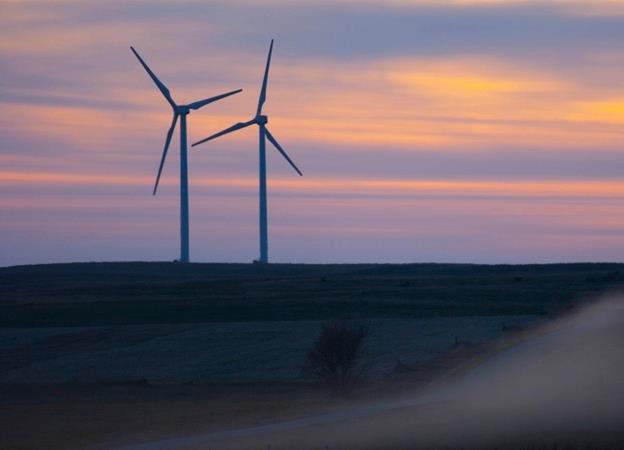
If transformative action is not taken now, the Paris Agreement goal target will be missed, according to Wood Mackenzie.
The world is on a 2.5°C warming trajectory according to Wood Mackenzie’s Energy Transition Outlook report.
If transformative action is not taken now, the Paris Agreement goal to limit the average temperature increase to below 1.5°C will likely be missed, concluded the report.
Low carbon power supply and infrastructure needs to scale up at twice the pace built in the last decade – made more difficult by the current delays faced by renewables assets due to limited grid interconnections.
A minimum of $1.4tn a year (base case) must be invested in renewables, infrastructure and energy transition technologies.
Annual spend into these sectors has to rise to $2.4tn to achieve net zero.
Oil and gas still have a role to play as part of a managed transition.
There will be a natural depletion as low carbon supply develops, but oil and gas supply will still have to be replenished as the world moves towards net zero.
Oil and gas spend will be $500bn a year in the base case, and $200bn a year for net zero.
Electricity is to become the major energy market, with renewables the main source of power supply.
Power demand doubles every 10 years to support road transport electrification and green hydrogen production.
Energy will have to be used much more efficiently in a net zero scenario with demand-side management a major component, softening the impact or rising electrification in other sectors.
“Supply security fears increased around the world, and higher prices across energy and mining commodities have fuelled inflation,” said Simon Flowers, chairman and chief analyst at Wood Mackenzie.
He added: “The supply of low carbon energy has grown by a third since 2015, but the world’s energy demand has grown much faster with rising incomes and populations.
“The good news is that sustainability is alive and kicking, spurred on by policy including the introduction of the US Inflation Reduction Act and Europe’s REPowerEU.
“Achieving 1.5°C is going to be extremely challenging, but it is possible and greatly depends on actions taken this decade,” Flowers added.
The combined share of wind and solar in Wood Mackenzie’s country pledges and net zero scenarios reaches 60% and 65%, respectively, in 2050.
This rapid growth in variable renewables is accompanied by 100% increase in the adoption of flexible assets such as energy storage, small modular nuclear and geothermal technologies, compared to the base case.
Power transmission infrastructure will also need to expand alongside renewables and the next phase of growth will require grid connectivity.
Wood Mackenzie expects that a carbon price of $150 to $200 per tonne is required by 2050 from the current global average of $25 per tonne.