


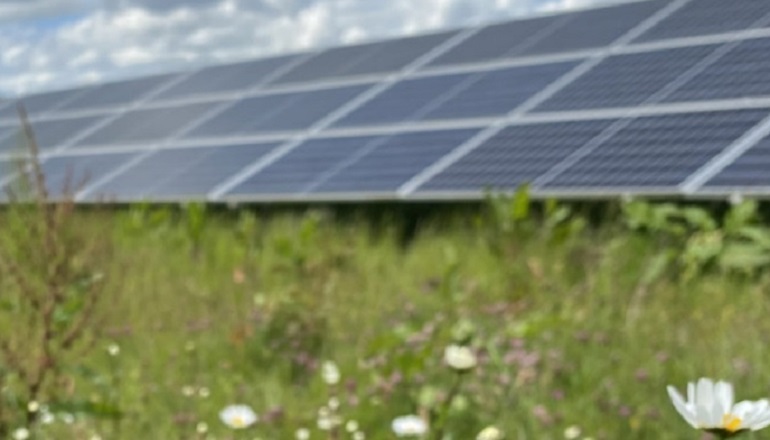
The first results of a national survey of wildlife on solar farms has found they are home to many declining species – with most seen on those specifically managed for conservation.
Insects living around ground-mounted photovoltaic panels could also benefit neighbouring agriculture by enhancing the number of available pollinators, the report concludes.
Linnets, a bird on the UK’s red list of conservation concern, were found across more than half of the 37 solar farms in the initial survey last year.
Numbers of the small finch species, known for its beautiful song, have fallen dramatically since the 1960s, thought to be linked to the intensification of agriculture.
Yellowhammers and skylarks, which have the same status, were also found on around half of the sites reported in Solar Energy UK’s Solar Habitat: Ecological trends on solar farms in the UK.
Grey wagtails, whitethroats, wrens and willow warblers, all amber listed by the British Trust for Ornithology, were also among the birds noted by ecologists last year.
Surveys were undertaken using the standardised approach to ecological monitoring set out by Solar Energy UK last year.
The report was produced with Lancaster University and consultancies Clarkson & Woods and Wychwood Biodiversity.
“It is very clear that solar farms can be wildlife havens,” said Hollie Blaydes, the PhD student who led the research.
“About half of the solar farms surveyed are managed with conservation specifically in mind, such as limiting grazing to only certain times of the year and reducing herbicide use.
“It’s on these where wildlife can really thrive and benefit from the habitats created.
“These findings and the net gain regime could help tilt the industry further towards improving biodiversity,” she added.
Skylarks were heard singing above the panels on half of the sites – an indicator of breeding activity nearby.
Although none of their nests have been observed on solar farms to date, possibly due to the species’ need for unbroken sightlines on the ground, it is possible that grassland around the panels may provide a valuable nursery habitat.
The most encountered mammals were brown hares, on a quarter of the sites surveyed. “It appears that solar farms offer ideal habitats for this declining species of conservation concern,” said the report.
Nine of the sites were home to the small heath butterfly, a species of principal importance under the Natural Environment and Rural Communities Act 2006 that has declined recently.
The more widespread but declining cinnabar moth, a species of conservation concern, was recorded on seven sites.
The report considers why some solar farms are more biodiverse than others, finding that the diversity and number of invertebrates were strongly associated with management being more focused on wildlife.
Almost all sites (94%) had some conservation measures, graded 2-3 on a 1-5 scale, where one is optimal.
“This report confirms what we have known anecdotally for many years: well-designed and well-managed solar farms can help address the climate emergency and loss of biodiversity in the UK,” said Rachel Hayes, Consents and ESG Policy Manager at Solar Energy UK.