


Canadian tidal energy company Sustainable Marine Energy has been placed into voluntary bankruptcy.
The company has appointed Deloitte Restructuring as trustee.
SME said it was not able to secure the authorisations it required or agree a viable path forward with Fisheries and Oceans Canada (DFO) that would enable it to deliver its flagship demonstration project at the Fundy Ocean Research Center for Energy (FORCE) tidal energy demonstration site in the Minas Passage.
Sustainable Marine CEO Jason Hayman said a decision was made to place the company into voluntary bankruptcy after receiving a letter from the Minister of Fisheries, Oceans and the Canadian Coast Guard, which “failed to provide investors with any confidence or certainty”.
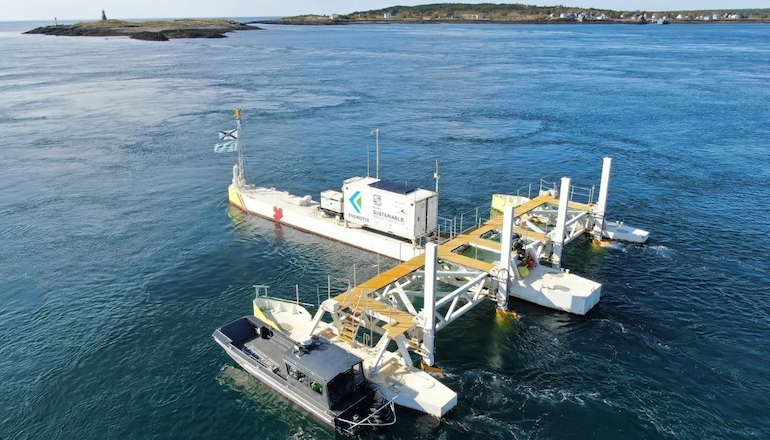
Last year, Sustainable Marine became the first firm in the world to successfully harness the enormous tidal currents in the Bay of Fundy and sell power to Nova Scotia’s grid using its innovative floating in-stream tidal platform (PLAT-I), it said.
Significant grant support was provided by Natural Resources Canada (NRCan) and the project at Grand Passage was delivered under a license provided by the Province of Nova Scotia.
An authorisation to operate a single platform during daylight hours only was provided by DFO.
Sustainable Marine planned to use the learning gained from the extensive testing of environmental monitoring technologies and methodologies performed in Grand Passage to deliver the Pempa’q Instream Tidal Energy Project at FORCE, in the Minas Passage.
With support from fish tracking and subsea imaging experts, more than 5000 hours of video data was amassed over a five-year period, beginning in 2018.
Findings remained consistent with all other studies completed over the last 20 years involving the deployment and operation of horizontal-axis in-stream tidal turbines around the world, with no negative interactions or harm to marine life observed.
Recently, the firm suspended its operations at Grand Passage, while conversations with government officials and the project investors continued to take place.
Hayman said: “We are enormously disappointed to be closing our business in Canada.
“Despite extensive environmental monitoring with no harm to marine life observed, DFO will not provide permission to proceed, nor a clear pathway or regulatory framework for the project to continue.
“This is a great shame considering not only our technology is ready, but there have also been massive investments in the tools and infrastructure necessary to deliver the project.
“I hope that officials within DFO will be able to come forward with a clear explanation to our team of 20 hard-working people in Nova Scotia, who have lost their jobs, plus many good and well-meaning people in Canada, Germany and the UK who have invested in the development of a clean and ultra-low environmental impact means of generating electricity.
“Like us, these people believed we were operating in a jurisdiction which places a high-value on transparency and science-based decision making, that wanted to accelerate the deployment of these types of solutions to help mitigate the impacts of climate change.”
To secure the site at Grand Passage and to ensure no lasting environmental impact, the PLAT-I platforms have now been placed into storage, with all equipment removed from the seabed at the site.