


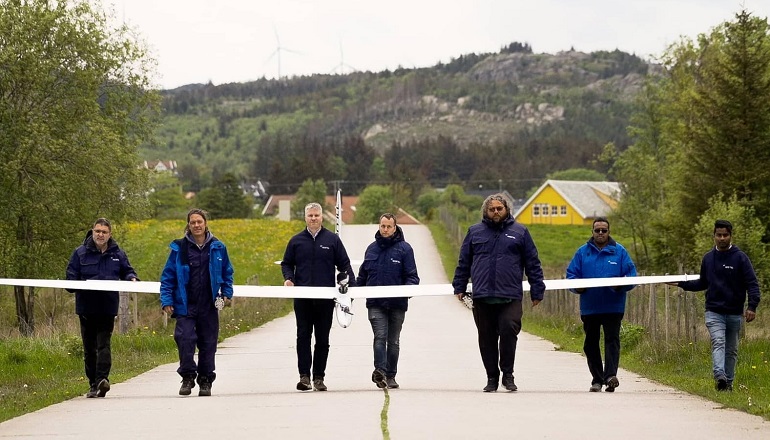
Norwegian start-up Kitemill has set a new record for airborne wind energy (AWE) covering more than 500 km and five hours of continuous operation with energy produced via its 20kW pilot plant.
AWE technology targets large untapped wind resources up to a half-mile above ground, where stronger and more consistent winds can be harnessed to generate greater energy yields at lower cost.
Kitemill’s KM1 pilot system consists of a kite, tether and ground station.
During production phase, the kite flies downwind in a circle building up lifting force by pulling on a tether, which is reeled around a winch at ground level and linked to an electric machine.
The automatic system constantly seeks optimal altitude and wind speed.
Established in 2008, the Norwegian firm has spent more than a decade building world-class knowledge, IP and assets, with acquisitions including Scotland’s Kite Power Systems (KPS) and Dutch firm eKite, plus significant investments from En-Vision Europe Limited Ignatia and the European Innovation Council.
Kitemill CEO Thomas Hårklau said it also marks another major milestone, surpassing 500 test flights with its KM1 pilot system.
“Our technology performed efficiently and robustly, despite challenging weather conditions,” he said.
“Operating at heights between 300 and 500 metres we are able unlock vast areas of high-capacity wind power, ensuring a stable energy output.
“As such, our technology is viable in many more sites compared to established wind technology. This will be an especially important factor in years to come as countries struggle to source suitable wind farm locations.
“In addition, AWE offers increased energy per square km, with around five times the energy density of conventional wind.
It also has significantly lower CAPEX – using just 10% of the materials required by wind turbines of the same capacity.
“Another considerable benefit is the ultra-low environmental impact.
“Barely visible from the ground, there is minimal environmental interference from construction through to operation.
“With less investment tied up to any given site, AWE technology can also be easily relocated during its lifespan.”
According to a recent white paper by BVG Associates, on behalf of Airborne Wind Europe, at utility-scale generation, the AWE market could grow to around €92.39bn by 2035-40.
Based on the assumption that the AWE market follows the same trend as the established wind turbine market 40 years ago, BVG further estimates the cumulative global deployment of AWE could reach 5GW by 2035 and at least 177GW by 2050.