


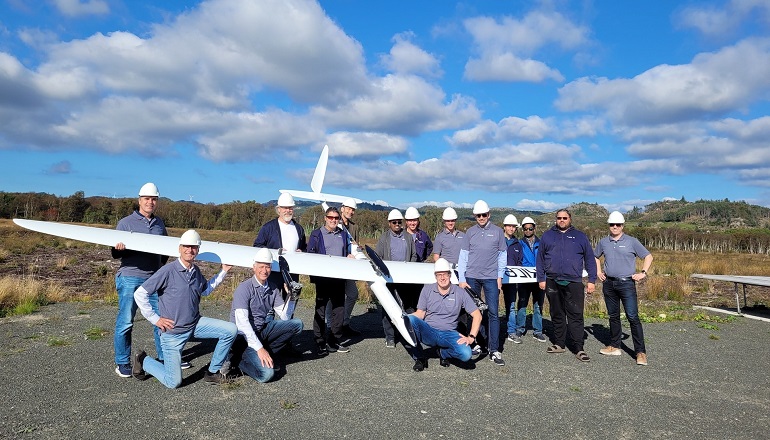
Airborne wind energy (AWE) developer Kitemill has attracted Norwegian utility Voss Energi as the lead investor for its latest crowdfunding campaign.
Voss has pledged Nkr3m (€253,000) in equity and significant resources to support Kitemill’s development of a test centre for AWE technology.
Established in 2008, Kitemill’s unique AWE technology unlocks areas of high-capacity wind energy up to half a mile above ground.
It has potential to half costs compared to conventional wind turbines and triple energy yield per unit of area.
The next phase of Kitemill’s expansion involves the launch of its first commercial-scale system, the 100kW KM2, with 12 units being supplied to the Norse Airborne Wind Energy Project (NAWEP).
According to a recent white paper by BVG Associates, on behalf of Airborne Wind Europe, at utility-scale generation, the AWE market has potentially to grow to around $100bn (€92.39bn) by 2035–40 and several hundreds of billions soon after.
Kitemill CEO Thomas Hårklau said Voss Energi’s involvement sends a strong signal to the marketplace. In addition to capital, it provides access to an integrated energy company with experience operating and owning energy assets, and knowledge of associated grid challenges.
He said: “Several start-ups and institutes are working on AWE, but Kitemill benefits from a number of key competitive advantages which will be critical for commercial success.
“Firstly, our system is fully automated following significant investments in control system development and demonstration.
“This is significant because AWE can only be commercialised if it operates autonomously in a reliable manner.
“Secondly, Kitemill has access to the world’s first formally approved test site for AWE.
Voss Energi CEO, Rune Nesheim, said ‘early mover’ status will provide the utility with competence and a significant commercial advantage to develop AWE projects once commercial products emerge.
Kitemill CFO Asgeir Lono said: “There are a number of interesting opportunities for Kitemill’s technology including remote off-grid applications.
“AWE can also be integrated into conventional wind parks on the towers or nacelles of wind turbines.
“This hybrid system will help reduce grid and balance of plant costs, while achieving a more stable combined energy output and a higher energy density.
“Eventually, utility scale projects will drive the high-volume deployment of AWE technology.”