


Tens of billions of pounds could be generated for the UK economy from the re-use, refurbishment and re-engineering of broken wind turbine parts, according to a new coalition.
The group, which so far comprises SSE Renewables, the University of Strathclyde, the National Manufacturing Institute Scotland (NMIS) and Renewable Parts Ltd, made the statement as it launched the Coalition for Wind Industry Circularity (CWIC).
CWIC has been set-up to drive the creation of a circular supply chain for renewables in the UK.
Building the capabilities to refurbish wind turbine parts in the UK could also generate more than 20,000 full-time equivalent jobs by 2035 and prevent more than 800,000 tonnes of parts from being scrapped.
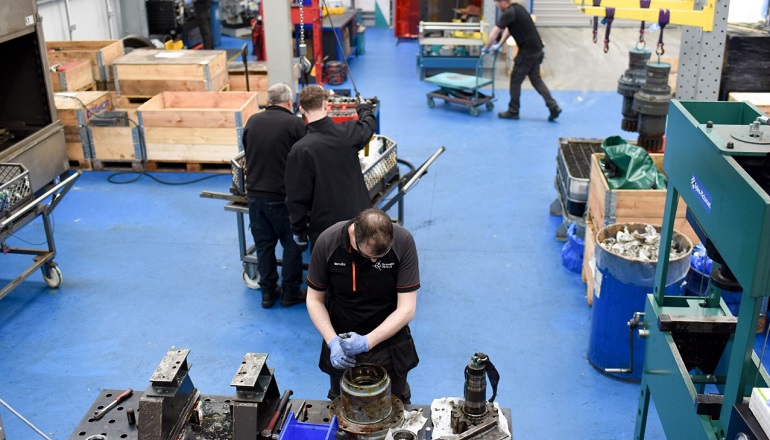
Typically, when wind turbine parts fail or reach the end of their life, they are replaced by new components, with old parts mostly ending up as scrap.
CWIC aims to change this, and establish a new, UK-based industry capable of moving towards a circular approach for replacing onshore and offshore wind components.
Analysis, which was commissioned by the CWIC, and undertaken by BVG Associates, found around 120,000 wind turbines (584GW of capacity) are forecast to be operational across the UK, Belgium, Denmark, France, Germany, the Netherlands, Poland, Portugal, Spain and Sweden by 2035.
According to this new analysis, a UK supply chain capable of refurbishing just 10 out of the thousands of parts which make up a single wind turbine could access a European-wide market worth almost £10bn to UK GDP between 2025 and 2035.
Building the capabilities in the UK to service more wind turbine parts as well as more export markets would increase this potential economic impact significantly.
CWIC has today also released research that found most organisations were supportive of the circular economy but struggled with implementation.
At today’s launch event for the coalition, Vestas, GE Renewables, Nordex and Enercon are coming together in Glasgow to participate in a panel discussion chaired by Chief Executive of trade body Scottish Renewables, Claire Mack, to provide openness on shared challenges and the need for greater collaboration across the industry.
Stephen Wheeler, Managing Director of SSE Renewables, said: “If the renewables sector exists to deliver the green energy the world needs for net zero, then we must face an uncomfortable truth: we can’t be sustainable without fighting climate change, but we can fight climate change in an unsustainable way.
“As a company we have already seen the direct commercial benefits from implementing circular solutions – from lower upfront costs to significantly reduced lead time for parts.”
Nick Sharpe, Director of Communications and Strategy at Scottish Renewables, said: “We know that 80% of a modern wind turbine is recyclable so there are clear opportunities for wind farm operators to harness a circular economy by increasing the reuse of component parts from decommissioned projects.
“The formation of the Coalition for Wind Industry Circularity sends a clear signal that the wind industry is committed to delivering a renewable energy circular economy for Scotland, and we look forward to working with more of our members as they join the Coalition and this initiative gathers pace.”
James Barry, CEO of Renewables Parts, said: “Our collective commitment to net zero means parts reuse must become the norm, not the exception.
“By rigorously applying circular economy philosophy, we can develop the technology to routinely remanufacture used parts and reduce carbon intensity.”