


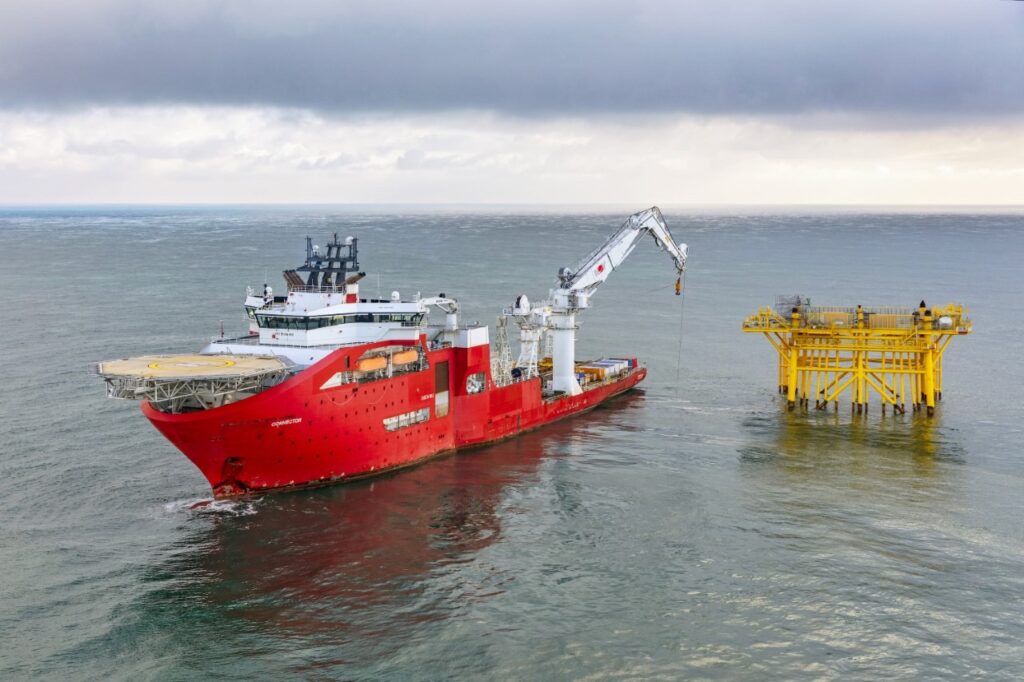
Jan de Nul Group and LS Cable & Systems has completed the installation of the first sea cable for Hollandse Kust West Alpha for TenneT in the Netherlands.
Using the cable-laying vessel Connector and the remote-controlled cable-laying vehicle UTV1200, in recent weeks, over sixty kilometres of lines were laid in the seabed between Heemskerk beach and the undercarriage (jacket) of the transformer platform at sea.
With over sixty kilometres of marine cable on board, the cable-laying vessel Connector from contractor Jan de Nul’s fleet appeared off the coast of Heemskerk/Wijk aan Zee in mid-December.
This cable section completed the first connection up to TenneT’s Hollandse Kust ‘socket’ (West Alpha).
Earlier last year, Jan de Nul pulled the two sea cables for ‘west Alpha’ from the Heemskerk beach into the jacket pipes under the dunes and the first kilometres of cables were laid capped in the seabed.
Some five kilometres from the beach, Jan de Nul pulled up the capped section of the first cable for ‘west Alpha’ in mid-December. On board the Connector, the end was then connected to the cable on board.
Following the connection by South Korean cable manufacturer LS Cable & Systems, the cable was placed back on the seabed.
At the same time, Jan de Nul’s work vessel Adhémar de Saint-Venant appeared offshore with the unmanned cable-laying vehicle the UTV1200 on board.
As soon as the Connector set sail, the cable slowly unwound from the large turntable on board. Followed a short distance away by the Adhémar to control the UTV1200, which then laid the cable into the seabed.
In mid-August last year, the steel undercarriage (jacket) for TenneT’s transformer platform was firmly anchored to the seabed 50 kilometres off the coast of Egmond op Zee.
Here, the first cable was successfully retracted through the cable deck in recent days. Next spring, Jan de Nul, using the cable-laying vessel Isaac Newton, will retrieve the remaining section for the second sea cable in South Korea so that this cable section can be installed.
This summer, TenneT will have the ready-made superstructure (topside) installed on the jacket for (West Alpha), so that the grid operator can bring renewable wind energy ashore via this ‘socket’ from next year.
With a capacity of 700MW, the amount of renewable energy brought ashore corresponds to 2.5 to 3% of current consumption in the Netherlands.