


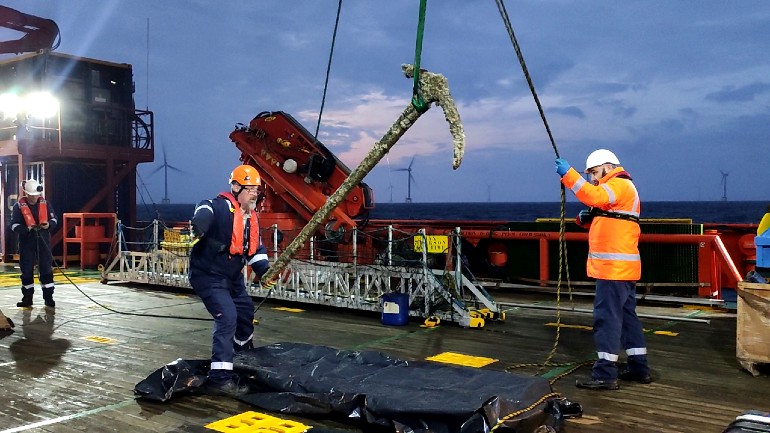
A wrought iron anchor found at the bottom of the southern North Sea during survey works for ScottishPower Renewables’ East Anglia 1 offshore wind farm is to go on display in Ipswich Museum.
Believed to be a rare example from the Roman or possibly late Iron Age – somewhere between 1600-2000 years old – the anchor could provide material evidence of ancient Romans seafaring and trading in the southern North Sea, off the coast of the East of England.
More than two metres long and weighing in at around 100kg, the anchor is estimated to have come from a 500-600-tonne vessel. If dated to the time of the Roman occupation of Britain, it’s most likely to have come from one of the larger merchant ships of the Roman fleet.
The anchor was first discovered in 2018 thanks to marine seabed survey works being undertaken by ScottishPower Renewables prior to the construction of its East Anglia ONE offshore windfarm, located around 40 km off the coast of Suffolk.
Protected by an exclusion zone installed on the seabed during the construction works and monitored using remote underwater technology due to concerns over its long-term preservation, the anchor was safely and carefully recovered from the water in 2021.
It is currently undergoing detailed imaging and analysis to better pinpoint its age and provenance. Once complete, this will allow the anchor to go on permanent display in conjunction with Colchester + Ipswich Museums.
The conservation works are being carried out by ScottishPower Renewables’ commissioned specialists Maritime Archaeology Ltd, in conjunction with the Mary Rose Archaeological Services, and with advice and guidance throughout the process from Historic England’s material science experts.
Brandon Mason from Maritime Archaeology Ltd, said: “If this date is confirmed, it would be hard to overstate its significance – we only know about three pre-Viking anchors from northern European waters outside the Mediterranean region and only two actually survived.
“We believe this find could be the oldest and one of the largest surviving examples, giving us hard evidence of the incredible amount of activity that must have been going on in the waters in Roman times, but that we know relatively little about.”