


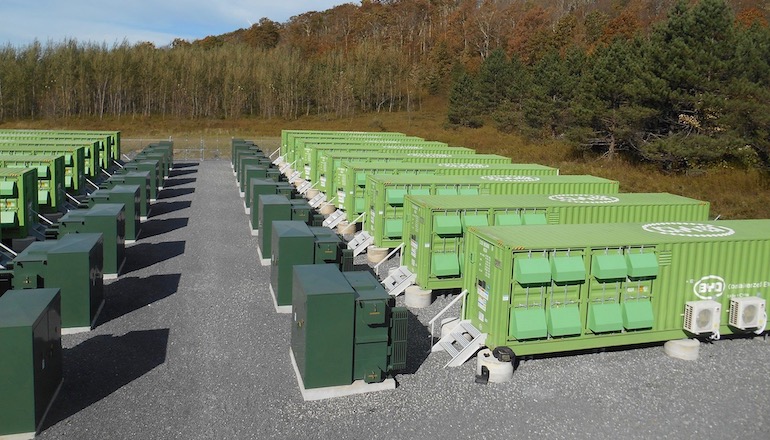
The US energy storage market set a new record in the second quarter of 2022, with grid-scale installations totalling 2608 megawatt hours (MWh).
This is the highest installed capacity for any second quarter on record, according to Wood Mackenzie and the American Clean Power Association’s (ACP) latest US Energy Storage Monitor report.
Grid-scale storage was boosted by a series of deployments in Texas, with the state contributing 60% of installed capacity in the quarter.
Vanessa Witte, senior analyst with Wood Mackenzie’s energy storage team, said: “Despite impressive growth, the US grid-scale energy storage pipeline continues to face rolling delays into 2023 and beyond.
“More than 1.1GW of projects originally scheduled to come online in Q2 were delayed or cancelled, although 61% of this capacity, 709MW, is still scheduled to come online in Q3 and Q4 of 2022.”
Supply chain issues, transportation delays and interconnection queue challenges were the main drivers behind delays in the commercial operations date (COD) for many projects, Witte added.
The US Congress passed a solar investment tax credit (ITC) extension and standalone storage ITC as part of the Inflation Reduction Act.
This critical piece of legislation will support all segments of the energy storage industry, increasing deployment of solar-plus-storage systems while also incentivising standalone facilities.
As a result, Wood Mackenzie forecasts 59.2GW of energy storage capacity to be added through 2026.
“The US energy storage industry is reaching maturity,” said Jason Burwen, Vice President of Energy Storage at ACP.
“Energy storage is now regularly being installed at over a gigawatt per quarter. In addition, Texas overtaking California this quarter should serve as a reminder that generators, customers, and grid operators in all geographies are increasingly relying on energy storage.
“Combined with the tailwinds of newly available tax credits from the Inflation Reduction Act, the question for investors and grid operators now is not whether to deploy storage, but how much storage to deploy – and how fast,” Burwen added.