


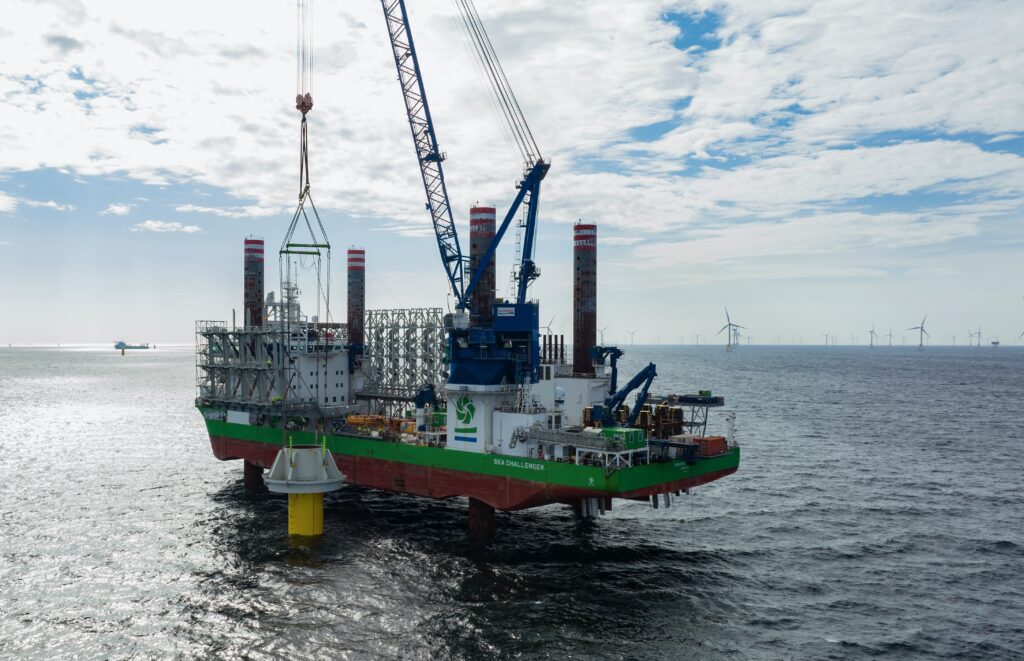
Special steel collars have been placed around monopile foundations on the seabed at the 342MW Kaskasi offshore wind farm for the first time, according to RWE.
The so-called ‘Collared Monopile’ was designed on the basis of a patent developed by RWE, the developer said.
The new technology will not only provide additional support for lateral loads, but will also increase the overall load-bearing capacity of monopile foundations.
This improves the stability of the entire foundation, it added.
The installation was carried out by DEME Offshore.
RWE Renewables chief executive for offshore wind Sven Utermöhlen said: “In our Kaskasi offshore wind farm, we use innovative technologies that set new standards in the entire offshore industry.
“It is a great merit of our project team and of our contractors that we have developed, manufactured and safely installed the three innovative foundation piles.
“Our Collared Monopile, a patented solution developed by us, increases stability in difficult soil conditions.
“This underlines our technical expertise as the world’s second largest player in the field of offshore wind energy.”
With Kaskasi, RWE is currently building its 6th wind farm off the German coast, around 35 kilometres north of the island of Helgoland.
The steel collars were laid on the seabed around a total of three foundations – each 7 metres high and weighing 170 tonnes.
The installation in a water depth of up to 25 metres was carried out by the installation vessel Sea Challenger from DEME Offshore.
The space between the collar and the monopile foundation was filled with joint material, so-called grout, to create a stable connection.
RWE will conduct accompanying tests to demonstrate that the steel collar improves the behavior of the foundation structure compared to standard monopiles.
The steel collars were designed by the German company JBO on the basis of the patent developed by RWE, Bladt Industries was commissioned with the production and DEME Offshore was responsible for the transport and installation.
DEME Offshore business unit director for Northern Europe at Bas Nekeman said: “Although the installation of the innovative steel collars is only a small part of the work that DEME Offshore is carrying out at the Kaskasi wind farm, we are very pleased to have reached this important milestone for the project.
“The installation is a world first, for which we have developed a tailor-made solution.
“The completion of the three Monopile foundations shows that we are able to provide our customers with the technical know-how, operational excellence and team spirit required to successfully execute innovative projects.”
Other innovations used in the Kaskasi wind farm include an innovative vibrating ramming technology and the Self-Expanding Pile Shoe, a foundation with a concrete ring that expands in the seabed.
In addition, a sustainable product will celebrate its German premiere at Kaskasi: Siemens Gamesa and RWE will equip some wind turbines with recyclable rotor blades.
Thanks to a novel resin, the rotor blades are the first of their kind that can be recycled for new applications at the end of their life cycle.
Construction of the wind turbines will begin in the summer.
By the end of 2022, a total of 38 wind turbines are expected to be operational. Kaskasi will then supply around 400,000 households per year with green electricity.