


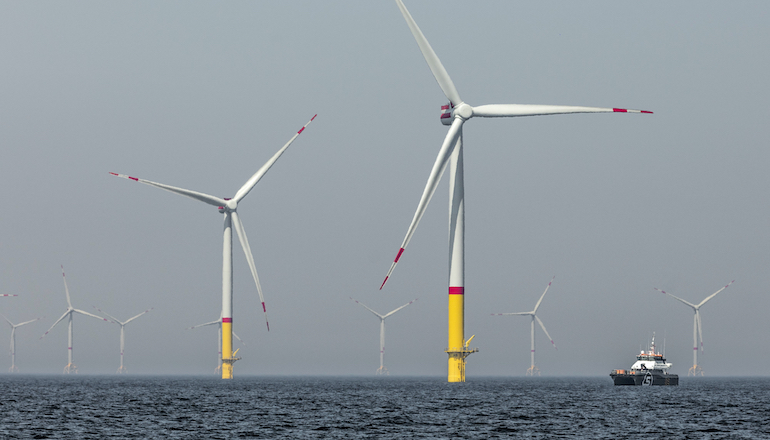
RWE is leading an academic-industrial consortium that is researching quieter pile driving technology that will be piloted at its 342MW Kaskasi offshore wind farm project.
The VISSKA project, is aimed at exploring the use of vibratory pile driving at the Kaskasi offshore wind project, in terms of installation, noise emissions and the impact on the behaviour of porpoises.
The other partners are Itap GmbH, BioConsult SH, the University of Stuttgart (Institute of Geotechnical Engineering) and Technische Universitut Berlin (Foundation Engineering and Soil Mechanics).
Kaskasi offshore wind farm is to be constructed 35 kilometres north of the island of Heligoland and is expected to be commissioned in the summer of 2022.
The innovative vibro pile driving technology uses vertical vibrations to drive the foundations into position, negating the need for additional noise reducing measures to protect marine mammals.
The pilot at Kaskasi is accompanied by a comprehensive research project, where the partners will develop forecast models for installing monopiles using the vibro pile driving method, the associated noise emissions, and to validate these models through measurements in offshore conditions.
In addition, the participating organisations are carrying out comprehensive, accompanying research on the behaviour of porpoises as a result of the lower noise installation technique.
The first measurements at sea are planned for the summer of this year and a total of 38 foundations for the wind turbines will be installed from the third quarter of 2021 onwards.
The final report of the 28-month research project is to be completed by early 2023.
RWE Renewables chief operating officer Sven Utermohlen said: “With the innovative vibratory pile driving method used at our Kaskasi offshore wind farm we expect shorter installation times and, due to the reduced noise emissions, it is also better for the maritime environment.
“Thanks to the support from the German Federal Ministry for Economic Affairs and in collaboration with our partners, we want to pave the way for the more environmentally friendly vibro pile driving technology.
“This project will help us achieve RWE’s goal of becoming a leader in advancing offshore innovation and technologies.”
Kaskasi will be the first commercial offshore wind farm in the world to use the improved installation method for driving the wind turbine foundations into the seabed to target penetration depth.
The German Federal Ministry of Economic Affairs and Energy is funding the research project, which is being coordinated by RWE.