


The five projects selected from the Offshore Renewable Energy (ORE) Catapult’s Clean Maritime Demonstration Competition (CMDC) have been completed.
The projects, representing £3.3m in funding from the Department for Transport and delivered in partnership with Innovate UK, helped pave the way towards a future of zero-emissions shipping with clean vessels and alternative fuels, ORE Catapult said.
ORE Catapult’s flagship project of the five was a feasibility study into the development of a National Clean Maritime Demonstration Hub in Grimsby, a ‘first step’ towards the development of an infrastructure and support ecosystem built to accelerate the deployment of clean maritime technology.
Alongside nine project partners, and industry advisors including RWE and Orsted, ORE Catapult produced a feasibility study to inform a business case for infrastructure-investment in zero-emission fuels/charging-infrastructure at the Port of Grimsby.
“It is hoped that the project will act as a catalyst to showcase Grimsby at the heart of the clean maritime sector and foster further collaboration in vessel decarbonisation within offshore wind,” ORE Catapult said.
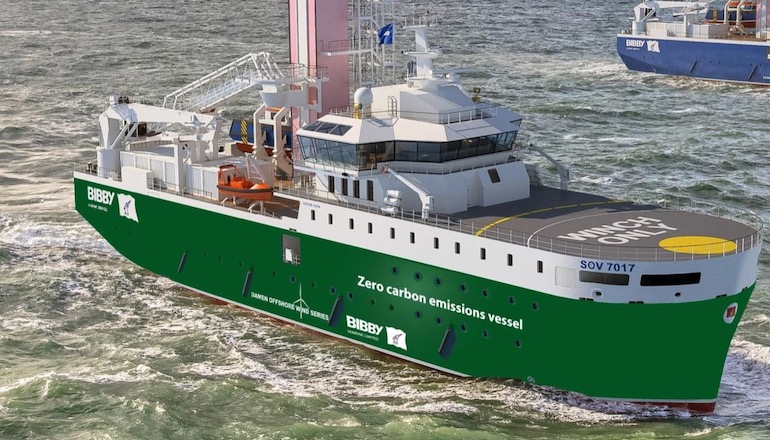
The other projects involved progressing innovations in electric crew transfer vessels (CTVs) through the Artemis eFoiler-CTV concept; a demonstration of a world-first electric charging point prior to real-world in-field trials; an investigation into data-led emission management; and a feasibility study on the development of an offshore wind power barge, providing vessel-to-vessel charging and battery swapping capabilities.
The outputs produced from the original five projects are expected to form the building blocks of future clean maritime programmes within offshore wind.
For example, MJR Power & Automation has announced that it will be extending its electric vessel charging system trials to a real-world environment later this year and the National Clean Maritime Demonstration Hub in Grimsby progressing to the next phase of deploying infrastructure.
Artemis will also be looking to develop its e-foiler concept further, through the build of an offshore wind CTV based on the feasibility study on the initial project.
Finally, some of the partners from the charging and battery swapping vessel project will use the feasibility study developed in this CMDC work as the foundation for a further project known as Zephyrus.
ORE Catapult clean maritime regional partnership manager David Cooper said: “As both a producer and user of clean fuels, the offshore wind industry can act as a first mover in the deployment of zero-emissions vessels, and act as a springboard for broader maritime decarbonisation.
“The completion of the CMDC projects mark a huge milestone in the industry’s journey towards net zero and its fantastic to see such impressive developments made in such a short space of time.
“We’re thrilled to have played a convening role, pulling expertise from a range of delivery partners across all the projects, acting as a blueprint for the future of vessel decarbonisation, not only within offshore wind but across the wider maritime sector.”
MJR Power & Automation managing director Paul Cairns said: “We’re delighted to join some of the leading players in both the offshore wind and maritime industries as part of these exciting projects. It is fantastic for MJR to play our part in several projects and support the offshore wind industry in its efforts to decarbonise.”
Tidal Transit commercial director Leo Hambro said: “The future of offshore wind logistics has to be as green as the energy that the farms produce.
“To achieve this ambitious goal the CMDC has enabled the development of an offshore charger and an electric foiling CTV.
“Tidal Transit are delighted to have been project partners in both of these and the support provided by ORE Catapult has added significant value to each.”