


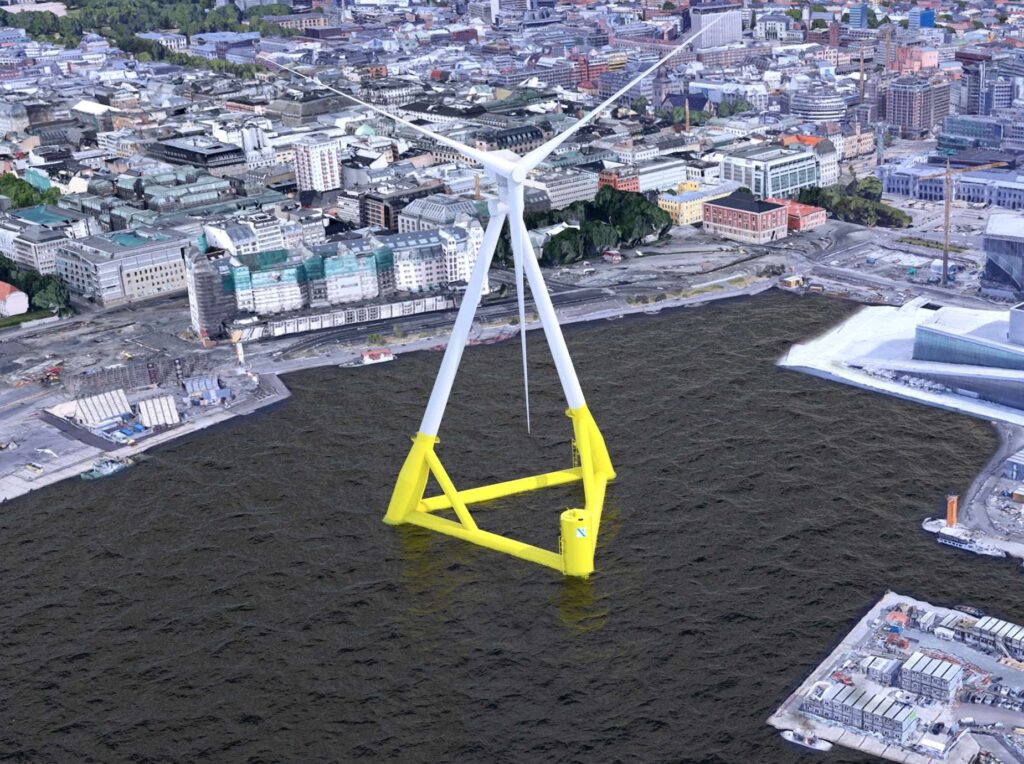
Fred Olsen 1848 has unveiled a new floating foundation named Brunel (pictured) after several years of development.
According to Fred Olsen the modular design enables Brunel to leverage the existing global supply chain and helps create a sustainable industry.
Fred Olsen 1848 chief executive Sofie Olsen Jebsen said: “The design of Brunel is based on a simple, yet challenging design philosophy: to see if we can build a foundation based on generic steel tubulars and hence enable manufacturing at commercial scale.
“This radical focus on commercial requirements, while at the same time attending to excellence on all technical parameters, will allow the floating offshore wind industry to realize its enormous potential.”
Brunel enters the market at an advanced technological stage, with a final tank test successfully completed at Sintef Ocean in February, according the company.
It also successfully received DNV’s statement of feasibility in April.
With the tank test and DNV statement of feasibility, Brunel has completed a significant milestone to reach Technological Readiness Level 4 (TRL 4), Fred Olsen said.
Working with Sintef Ocean, a Physical-Numerical Validation Approach will be applied to demonstrate and qualify Brunel according to standard procedures from oil and gas and maritime, that is to say, exempting the need for piloting and full-scale demonstration.
Through this process, Brunel is expected to reach TRL 8 at an accelerated pace and will be ready for commercial application within three years.
Fred Olsen 1848 will involve leading engineering and fabrication specialists in the process to ensure the requirements of the industry are being addressed; both technically and commercially.
The developer said it is in close co-operation with customers and other partners to position Brunel as the floater of choice for the large scale floating offshore wind farms to be built.
Brunel harnesses the advantage of sourcing and procurement from an existing global supply chain, it added.
Fred Olsen said this will de-risk the floating offshore wind projects and offer a high degree of flexibility to maximise the local content footprint, which again will support individual countries’ ability to grow the floating offshore wind industry both domestically and internationally.
Olsen Jebsen added: “Brunel is designed for the next generation of wind turbines.
“With its low LCOE and ability for serial and mass production, we believe the Brunel to be a game-changer that can unlock the potential of floating offshore wind.”