


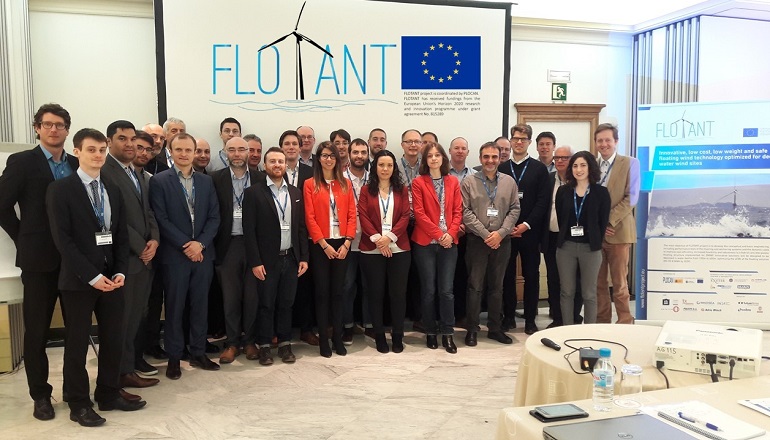
Innosea has completed its engineering and consulting scope of work on the European Horizon 2020 funded Flotant project to develop an optimised mooring, anchoring and subsea interconnection arrangement for floating offshore turbines.
The multinational collaborative project has developed a concept design and basic engineering for a hybrid concrete-plastic floating wind farm platform, looking at innovative solutions for anchoring, mooring systems, and dynamic cabling.
It included a global performance assessment of the new concept, with the objective to find a solution, which improves cost-efficiency, robustness and flexibility in floating wind subsea design for deeper waters from 100 to 600 metres water depth.
Innosea project manager at the Flotant project Jordi Serret said: “The results, including the development of a new concept for high-performance dynamic cabling, will play a key role in supporting the further expansion of floating wind technology into even deeper waters, unlocking higher wind resource at lower production cost.”
Innosea completed engineering deliveries in three areas.
First, hydrodynamic assessment and dynamic cable configuration determination and optimisation to develop a lightweight and high-performance dynamic cable.
Second, stability analysis and wave-structure interaction analysis to develop a new solution for offshore floating substructure.
Third, coupled simulations and global performance assessment of the integrated Flotant solution.
Flotant, which kicked off in 2019, is due for completion in spring 2022.
The project’s results will be presented at the upcoming WindEurope Exhibition in Bilbao.