


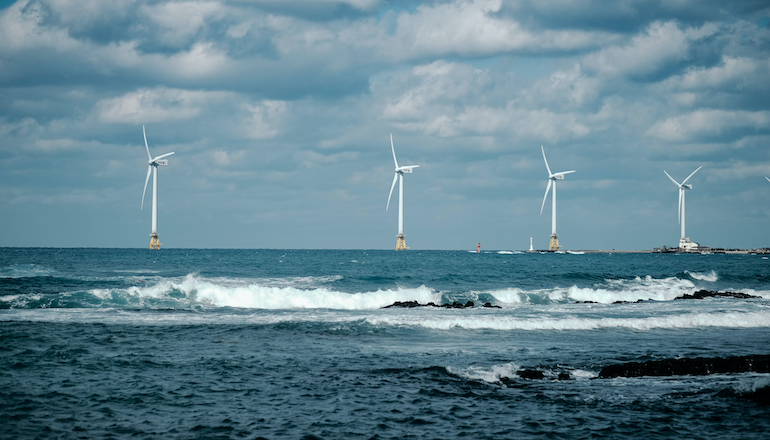
The Crown Estate has endorsed a proposed “stepping stone” approach to leasing in the Celtic Sea, which would see a focus on two key project categories.
Recent market engagement, which was reopened in February, reaffirmed a strong appetite for early commercial and commercial scale projects, Crown Estate said.
These are early-commercial scale projects of around 350MW and full-commercial scale projects of up to 1GW, to help enable greater regional supply chain participation.
The move came after it completed phase two of market and stakeholder engagement on plans for up to 4GW of floating wind leasing in the area off the south west of England and Wales.
Last month, Crown Estate hosted a workshop attended by over 70 stakeholders with an interest in the Celtic Sea.
This included representatives from environmental, fishing, marine and ports organisations, as well as UK Government representatives.
The stakeholder event, which built on earlier engagement, was an opportunity to receive input on the criteria that will underpin the spatial design for floating wind leasing, to identify potential areas for wind development.
The areas identified through the spatial design work will then be taken forward as part of the integrated Habitats Regulations Assessment and spatial refinement for the Celtic Sea leasing programme.
This ongoing stakeholder engagement is an important part of ensuring that protecting and, where possible, enhancing coastal and marine environmental habitats, which is at the heart of the leasing approach, Crown Estate said.
It has also been engaging with the market to invite views on a range of factors which influence the spatial design of project locations, their size, sequencing and timing.
These include ports and supply chain, technology types, and electricity grid readiness.
Through the engagement, the market also shared views on preferred floating wind technology types, and how to deliver a coordinated grid solution to help accelerate grid development and mitigate impacts on communities onshore.
Feedback also included the need for investment in both UK supply chain and port infrastructure to help realise the scale of the ambition of the programme.
Crown Estate senior development manager Tim Stiven said: “Floating offshore wind has the potential to play a pivotal role in meeting the UK’s net zero goals, delivering clean energy in new areas offshore, and creating new jobs and growth in a burgeoning industrial sector.
“We are committed to collaborating with stakeholders and the market throughout this journey and are grateful to those who have taken the time to engage with us.
“The findings from these latest phases of engagement are extremely important in helping to meet the clear demand and potential for floating wind in the Celtic Sea, in coexistence with the myriad other important and complex interests and pressures on and offshore.”
In total, industry representatives and Celtic Sea stakeholders from around 100 organisations have participated in the engagement to date.
Crown Estate will now continue to engage with a range of specialist stakeholders on key topics including defence, navigation, fisheries, cables and biodiversity with further information to be published as the spatial design work develops in mid-2022.
It is also considering pre-consenting survey work in the Celtic Sea, including further environmental and engineering surveys, to inform the design and accelerate the development of floating wind projects.
The scope for these surveys will be defined in collaboration with market and stakeholders.