


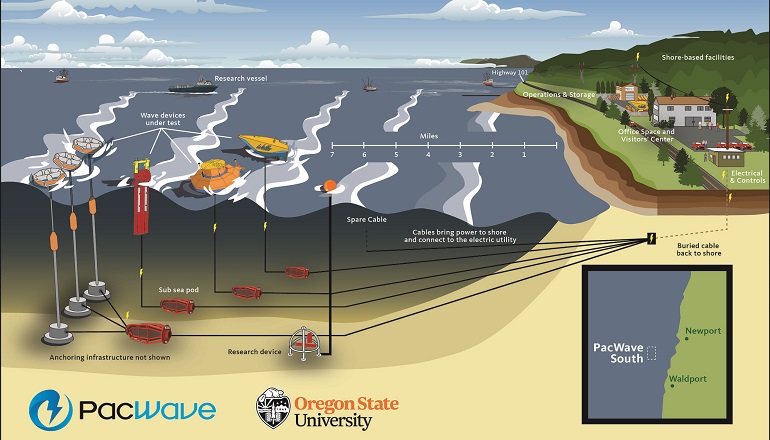
The US Department of Energy (DoE) has awarded $25m to eight recipients to test wave energy technologies at Oregon State University’s PacWave South facility off the central Oregon coast.
Portland State University, with a $4.5m award, is among the funding recipients.
The University of Washington, which is receiving $1.3m, is the other university among the funding recipients.
The remaining six groups are CalWave Power Technologies of Oakland, Columbia Power Technologies of Charlottesville, Virginia, Dehlsen Associates of Santa Barbara, Oscilla Power of Seattle, Integral Consulting of Seattle and Littoral Power Systems of New Bedford, Massachusetts.
The funded projects will focus on wave energy converter designs for use in geographically remote areas or on small grids.
These converter designs can be either connected to or disconnected from the grid.
The funding also supports research and development related to environmental monitoring, instrumentation systems that operators use to control wave energy converters and other technologies.
Construction began in June 2021 on the approximately $80m facility, to be located about seven miles offshore.
When completed, PacWave South will be the first commercial-scale, grid-connected wave energy test site in the United States.
It is expected to be operational in 2023, and grid-connected testing is anticipated to begin the following year.
“The DoE’s announcement represents an exciting new development in the pursuit of producing renewable energy from ocean waves,” said Oregon State’s Burke Hales, who is PacWave’s chief scientist and a professor in the OSU College of Earth, Ocean, and Atmospheric Sciences.
Hales added: “This commitment to in-water testing at the PacWave site is the bridge from conceptual or scaled-down designs to operational power production in the fully energetic open ocean.
“It also shows the agency’s long-term commitment to the completion and operation of the PacWave test facility.”