


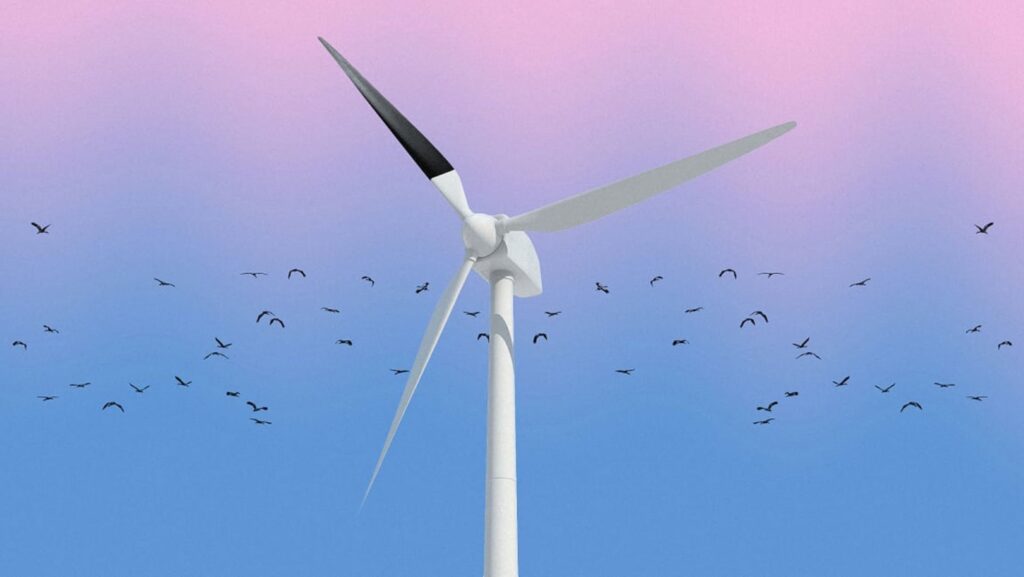
Vattenfall is to paint one of the blades of seven wind turbines black at a Dutch wind farm to see if it can reduce bird collisions.
Research in Norway funded by the Swedish developer found that black blades can reduce the number of bird collisions by 70%.
Vattenfall is now looking at whether Dutch birds follow the same behaviour and if dark-coloured wind turbine blades would be accepted by the public in the Netherlands.
The study at a wind farm in Eemshaven has already started and is expected to run until the end of 2024.
This year a baseline measurement will be done.
Next year, the blades will be painted and for two years, the turbines be monitored whether that has an impact on the number of bird collisions.
In addition, aviation safety and the impact of the painted blades on the landscape will be examined.
The Norwegian study on the island of Smøla in Norway showed that painting one blade resulted in 70% fewer collisions.
Vattenfall environmental expert Jesper Kyed Larsen said: “That has to do with the way birds perceive the moving rotor of a wind turbine.
“When a bird comes close to the rotating blades, the three individual blades can ‘merge’ into a smear and birds may no longer perceive it an object to avoid.
“One black blade interrupts the pattern, making the blending of the blades into a single image less likely.”
However, the Netherlands is home to other bird species and the landscape is very different from that in Norway, as is the meteorological conditions.
Jesper Kyed Larsen added: “We are continuously looking at ways to reduce the impact of wind turbines on the environment, and we are therefore very excited to be part of this study at Eemshaven to better understand the potentials of the black blade measure in a Dutch context.
“If we could find other ways of reducing collision risk to birds than temporarily stopping the turbines, and losing renewable energy production, that would of course be better for everybody.”
One point of discussion in the Norwegian study was that black blades are more conspicuous, not only to birds but to humans too.
The question was whether the surrounding area would be affected by the visual effect.
Another Vattenfall environmental expert Bjarke Laubek said: “Norway’s west coast is not known for its blue skies and sunshine.
“On the contrary, it often has grey and rainy weather or days with mixed cover of often fast-moving clouds giving a very patchy illumination of the landscape and turbines within it.
“The black blades therefore hardly stood out in the landscape, no more than the grey blades in any case.
“The people living in the area didn’t seem to be too bothered by it, and the black-painted blades were therefore allowed to stay until the end of their lifespan instead of just for the duration of the research project.
“In the Netherlands, we have clear blue skies more often than in Norway.
“The light setting on the turbines is therefore different, but it is still difficult to estimate how noticeable the black blades will be in a Dutch landscape. “
It will also be important to gain more knowledge about the practical and financial aspects of the black blade measure in a Dutch context.
Will the black paint affect the durability and as a result the maintenance needs for the blades? The study at Eemshaven will be considering this as well.
Vattenfall is participating in the black turbine blade pilot project together with a number of energy companies and Dutch public authorities such as Groningen Province.
The windfarm in Eemshaven is owned by RWE.
In 2020, Vattenfall completed and extensive research project into the behaviour of birds in the vicinity of wind turbines in North Jutland in Denmark.
Kyed Larsen said: “The research showed that the birds studied were much better at avoiding colliding the wind turbines than expected.
“Well above 99% of the pink-footed geese and cranes flying in the area were able to avoid the turbine blades.”