


Innovations set to benefit the UK’s onshore and also offshore wind industries are among the recipients of a share in £116m in government funding.
The funding will see projects across the country “play a key part in the UK’s green industrial revolution”, putting British business at the forefront of green innovation – helping to generate green jobs and kickstart millions of pounds of private sector investment.
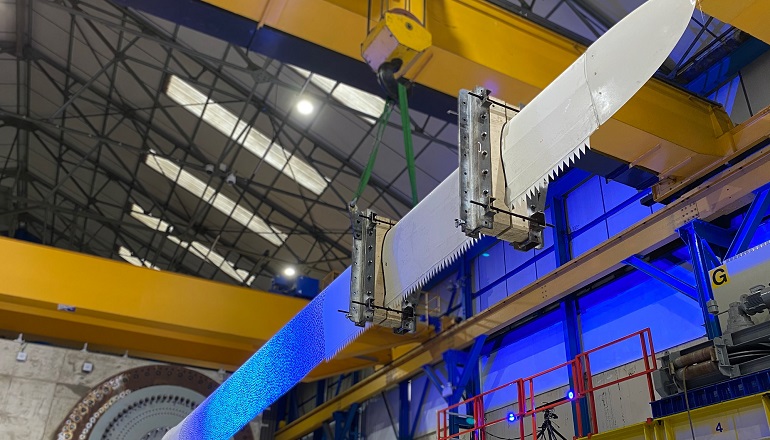
Wind-focused recipients and projects include ACT Blade, which intends to design the first commercial product, the ACT100, and prepare all necessary documentation and tests and plans to achieve certification.
ACT’s blade is made of an internal composite structure and covered by engineered textile, it can be up to 32% lighter than conventional blades, enabling longer blades and directly contributing to the production of 9% more energy with a 7% reduction in the cost of energy.
Following a successful test at the customer site, ACT Blade aims to enter the market in 2023.
ORECatapult, as project partner, will support all stages of the test development and execution, in addition contributing to the dissemination of the results.
This is a “key step to successful commercialisation and adoption of the ACT Blade technology”, by enabling the market entry by ensuring the first prototype will achieve certification and can proceed to be tested on a real pioneer customer’s turbine by the end of 2022, ACT Blade said.
Another funding recipient is the Windscope project, which brings together wind turbine specialist engineers, machine learning specialists and industry representatives to develop a condition monitoring platform that will enable a flexible and independent predictive maintenance capability for offshore wind operators.
The platform will be tailorable to any turbine design and will be licensed to operators on a perMW subscription, allowing for maximum flexibility.
The platform will link to existing SCADA systems and target the most critical turbine systems which account for the majority of maintenance activity and cost.
The project will utilise concepts and technological development processes previously developed for delivering condition monitoring in the civil nuclear sector where Ada Mode’s technology has been shown to deliver considerable benefit to operators, with very short return on investment timescales.
Cedeco has secured funding for its mechanical alternative to grout, designed for offshore wind turbine foundations.
The technology won an open innovation challenge sponsored by SPR and OREC.
Grout-free foundation installation means a reduction in installation time and cost and an increase in health and safety (less people and vessels are required at sea), Cedeco said.
Working with BEIS, Cedeco and collaborators aim to progress this technology as part of the commercial roadmap leading to commercial deployment in 2025.
Renewable Dynamics will invest its funding support in developing a yield optimisation wind farm controller that maximises a wind farm’s profitability.
This is done by intelligently adjusting the wind turbine production setpoints across the wind farm according to a “cost-benefit algorithm that balances profits and life”.
Over the last year, the solution has been developed and tested in simulation using generic turbine models.
This project takes this solution to the “next level” by working with Red Rock Power Limited to use data from one of its wind farms to train the models and show the solution’s “true economic potential”.