


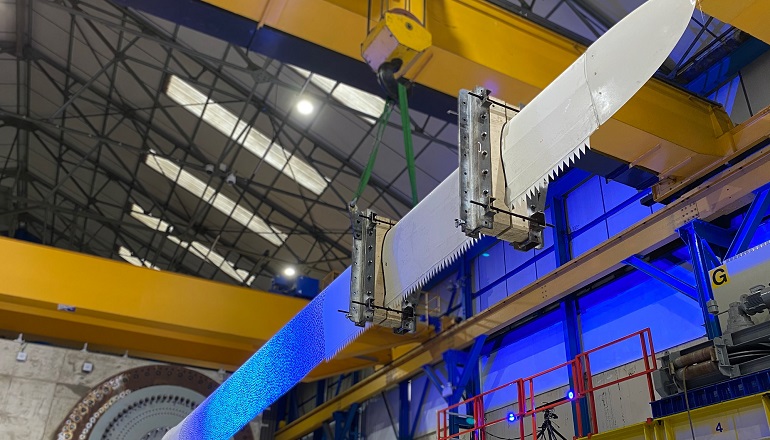
ACT Blade has finished initial testing of its new wind turbine blade at the Offshore Renewable Energy (ORE) Catapult’s site in north-east England.
The successful completion of the first of two static tests at the National Renewable Energy Centre in Blyth paves the way for the lightweight blade’s first operational deployment later this year.
The test involved exposing the blade to a simulation of tough offshore wind conditions over three weeks to “push the limit” of structural integrity and durability, said ACT Blade.
The company said test results reveal the blade is able to withstand extreme loads and all directions, going beyond those predicted for an in-service turbine, while post-test inspections show it to have held its shape with no damage.
The test data, which includes optically measured strain and deflection results from within the blade textile, is being analysed to gain a fuller understanding of the blade’s behaviour.
Over the next six months ACT Blade will work with the Energy Technology Centre to prepare for installation of three blades on a working wind turbine at the Myres Hill wind farm in Scotland, as a further step towards commercialisation of the blade.
ACT Blades said its blades are 24% lighter, enabling longer dimensions by up to 10%, compared with the standard 55 metre blade for onshore wind turbines. Longer blades produce 9% more energy and reduce the cost of energy by 6.7%.
ACT Blade chief executive Sabrina Malpede said: “I realised that the offshore wind industry was engaged in the same race as we were in the yacht-racing world: we need to reduce loads and capture more wind power without compromising on durability.”
“Today, I am delighted that after three projects funded by Innovate UK, we have proven our concept.
“I would like to thank all our partners who have made this breakthrough possible: ORE Catapult, Advanced Materials Research Centre, Advanced Forming Research Centre, the Energy Technology Centre (ETC) and InnoEnergy.”
Edinburgh-based ACT Blade was spun off from UK yacht-sail developer SMAR Azure in 2015.
The company’s blades are made of an internal composite structure and high-tech textiles, as opposed to the fibreglass, to achieve the lighter weight.
ORE Catapult research and disruption innovation director Stephen Wyatt said: “This is great news for the development of novel wind turbine blade designs, ensuring we can continue to improve offshore wind productivity and reduce costs, embedding offshore renewables at the heart of the UK’s future energy mix.
“The ACT Blade team has pushed the limits of what is physically possible, putting UK technology in pole position in the innovation race. It’s also an inspirational story, showing how an Eureka moment can be turned into a future export that could generate billions in revenue for the UK.”