


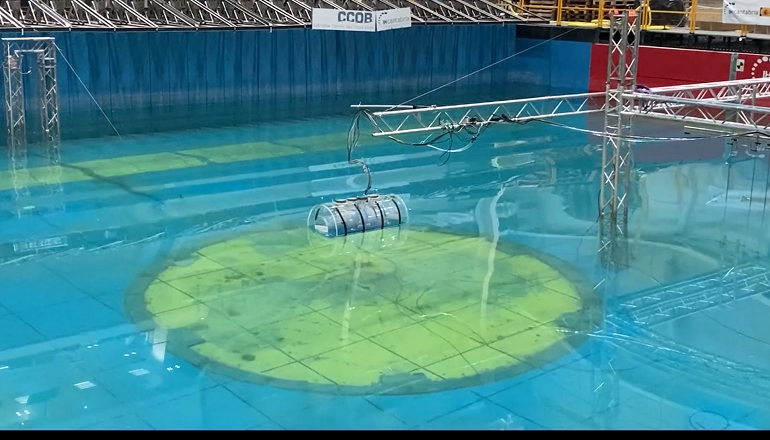
Innosea has supported the wave basin testing of a wave energy prototype developed by French start-up Seaturns.
Innosea was appointed in January of this year by Seaturns, to support testing, calibration and characterisation of its innovation in realistic sea conditions.
The Seaturns prototype benchmarks existing wave energy conversion technologies with the challenges that could hamper its scalability.
The aim is to develop a model that is resistant to different sea conditions, with energy conversion ability corresponding to different types of swell.
The prototype has also been designed to minimise and facilitate maintenance operations, reinforce ease of installation and increase the technology’s versatility for deployment in different markets.
Innosea’s scope of work included supporting Seaturns in establishing a test plan and providing near real-time data analysis to support future decision making.
The testing was successfully carried out in Cantabria Coastal and Ocean Basin (CCOB)’s wave basin, in Spain.
This created an environment as close as possible to real sea conditions, using a tank testing procedure developed by Innosea.
“It has been impressive to see how the prototype reacts to various adverse sea states, which are realistic to the conditions it will experience post-deployment.
“Seaturns’ prototype seeks to resolve the many technical challenges impeding commercial development of wave technology, which if scalable could unlock vast untapped carbon-free energy from a highly dependable source,” said Remy Pascal, specialist engineer at Innosea.
As a result of the trial, a new catenary mooring configuration was selected as the project moves forward into development.
The new mooring concept proved to enable greater performance from the prototype at key periods.
The wave basin test was funded by MaRINET2 (Marine Renewables Infrastructure Network for Enhancing Energy Technologies), an EU Horizon 2020 funded project.