


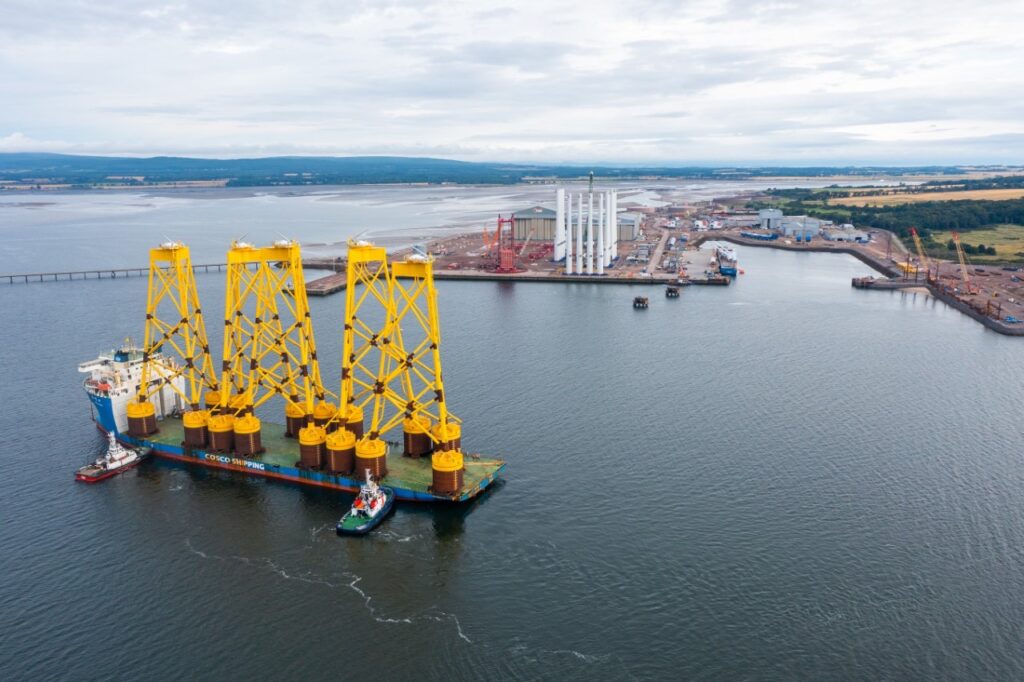
Creation of a Scottish Floating Offshore Wind Port Cluster would leverage supply chain benefits and deliver over £1bn in economic benefit to Scotland, according to a new report.
The report, commissioned by the Scottish Government and offshore wind industry and led by professor Sir Jim McDonald at Strathclyde University, sets out a series of five recommendations to transform how Scottish companies secure work in offshore wind.
Among them is the cluster, which could bring the manufacture of floating offshore wind platforms to Scotland, with ports acting in partnership to provide the required infrastructure area and capability needed to attract manufacturers to use Scottish ports and invest in Scotland.
The study highlights a low-regret option to invest in an additional 22 hectares of port capacity suitable for offshore wind platform fabrication that could deliver £1.5bn in economic benefit to Scotland.
This initial investment could help underpin longer-term growth in port space, and further investment in port capacity could grow this figure to £4.5bn.
The report said a new partnership approach is needed to help ports invest so they are ready to support projects coming out of the current ScotWind Leasing round run by Crown Estate Scotland.
The SIA also identifies Scottish subsea engineering companies as a priority group well suited to offshore wind, and sets out a range of actions needed to help them better engage with and win work from top tier offshore wind companies.
Scottish projects installed between today and 2027 may produce a total lifetime spend of £18.8bn, resulting in an average of 1900 direct jobs per year during construction and 1100 jobs per year during 25-30 years of operations.
McDonald said: “Scotland is a leader in climate action as well as in low-carbon technology, research and innovation, with a commitment to a just energy transition.
“Scotland will be one of the first countries in the world looking to deliver floating offshore wind at scale. If Scottish companies are involved in this first generation of floating offshore wind projects, then they will be in a position to sell this expertise around the world.
“However, winning this opportunity will need collective effort and determination. Scottish Ministers and industry leaders must clearly understand and provide the level of commitment and action needed, and create the opportunity to forge an effective partnership if we are to grow Scottish success.”
Net zero and energy secretary Michael Matheson said: “The offshore wind sector has a vital role to play in decarbonising our energy system and ensuring we become a net-zero economy by 2045.
“With a pipeline of new projects set to be provided by the first cycle of ScotWind Leasing, the Scottish Government committed to setting out this Strategic Investment Assessment within our first 100 Days of Government as we seek to better support the offshore wind supply chain and create further good, green jobs as we deliver a just transition to net zero.”