


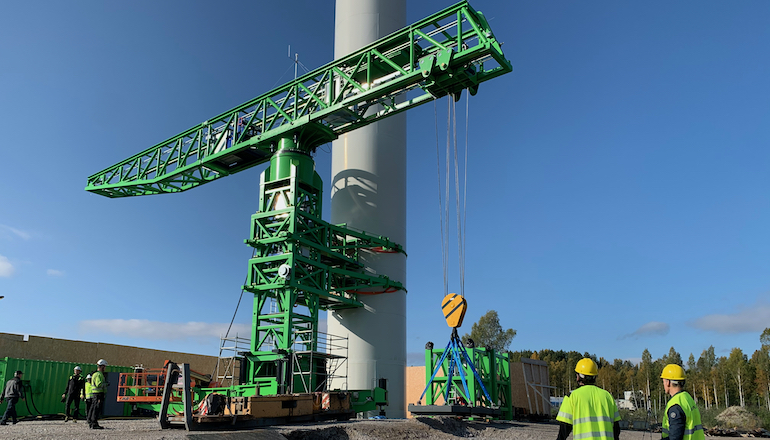
Vestas Ventures has invested in Swedish company S&L Access Systems’ Salamander Quick Lift Crane Technology.
The aim to further strengthen Vestas Ventures’ position in sustainable energy solutions and to reduce carbon emissions from its value chain.
The corporate venture capital arm of Vestas said the new crane “holds significant potential, both in sense of being safer to work with, as well as being simpler to bring to site, assemble and work with, compared to standard cranes”.
It added that relocation within the site and decommissioning is also faster with the crane.
The technology enables heavy lifts on hub heights beyond 200 metres, Vestas said.
“The moveable platforms are less wind sensitive when conducting uptower works, and the crane requires a smaller pad,” it added.
The crane can be used for both installation and maintenance of legacy, current and future turbines.
The investment means Vestas becomes the minority investor in S&L Access Systems, a subsidiary of Stena.
It is the second official investment from Vestas Ventures in 2021, with the unit making its first investment in wood-technology company Modvion.
Vestas head of innovation and concepts Bo Svoldgaard said: “Vestas Ventures was established to make venture investments in innovations that contribute to accelerating the green energy transition.
“The Salamander Quick Lift Crane Technology is primarily based on proven technology and enables safer and more cost-effective lifts of heavy components even at the highest hub heights when building, servicing, and maintaining wind turbines.
“By accelerating the market adoption of this high potential technology, we could reduce the cost of energy through reduced installation time, CO2 emissions and simplifying crane transportation, which contributes to maturing the industry in a more sustainable way.”
S&L Access Systems chief executive Marcus Dahlinder said: “We are excited to be partnering with Vestas in this unique product.
“Today, onshore wind turbines tend to be higher and soon to reach hub heights beyond 200 metres, wind power projects are more complex and often located in remote areas.
“As the importance of the wind turbine industry increases and turbines become taller and more powerful, we are well positioned with this unique crane solution enabling high safety and efficient lifting of high wind turbines in a more sustainable way, than traditionally.
“The concept demonstrator is already undergoing functionality tests while the prototype is under construction in close cooperation with our partners.
“Construction will be completed by the end of the year and testing will continue promptly.”