


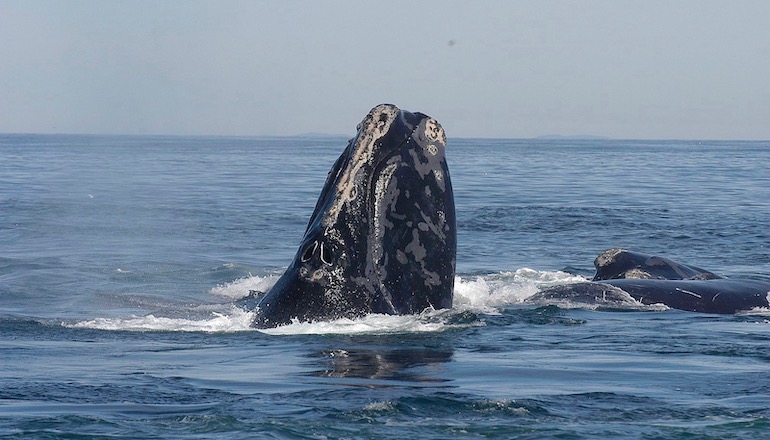
US Wind has deployed an ocean buoy that will monitor and provide daily reports of whales detected off Maryland’s Atlantic coast.
The deployment is in coordination with the Maryland Department of Natural Resources (MD DNR), Maryland Energy Administration (MEA), University of Maryland Center for Environmental Science (UMCES) and Woods Hole Oceanographic Institution.
The buoy, which is located about 37km offshore in the Maryland offshore wind ease area, will monitor the presence of a wide range of baleen whales that either call the ocean offshore Maryland home or pass during migration along the coast.
It includes an underwater listening device called a hydrophone that will record the marine mammal calls.
A detection algorithm will also analyse the calls to determine the presence of humpback, fin, sei, and the critically endangered North Atlantic Right whale species (pictured).
The data collected will be transmitted to shore, verified by UMCES scientists, and shared daily on the buoy website – robots4whales.whoi.edu.
The data from the monitoring buoy will help further advance the ongoing research efforts of Helen Bailey with the Chesapeake Biological Laboratory at UMCES to understand the distribution of marine mammals off Maryland’s shoreline and characterise the current ambient noise environment.
Deployment is scheduled for at least one year and will support current and near-real-time alerts to help inform on-water changes in vessel traffic and develop recommendations for mitigation efforts to protect marine life during construction and maintenance of Maryland offshore wind activities.
US Wind director of permitting Todd Sumner said: “The deployment of this whale monitoring buoy is a major achievement for science and research.
“US Wind is proud to have coordinated with Maryland DNR, the University of Maryland Center for Environmental Science, the Maryland Energy Administration, and WHOI on this effort to monitor marine mammal activity in our lease area.
“The information obtained from this buoy will ensure greater protection of marine life in our lease area, including the critically endangered North Atlantic right whale.”
US Wind acquired an 33,588-hectare federal lease area off of the coast of Maryland in 2014.
In 2017, the company was awarded Offshore Renewable Energy Credits (ORECs) from the state of Maryland for the first phase of its MarWin project.
In total, the company’s lease area can support approximately 1.5GW of offshore wind energy capacity.
Bailey said: “It’s wonderful to be able to use this state-of-the-art technology to provide alerts about endangered whale species offshore of Maryland.
“Many people don’t realise that whales pass by the Maryland coast during their winter migration.
“These real-time detections will be freely available on the Whale Alert and Ocean Alert apps so mariners can see when whales are in the area and slow down to help avoid collisions with whales.”