


Orsted believes the additional 12700MW of offshore wind projects it wants to secure and install this decade will all come from fixed-bottom assets.
The developer is pursuing the extra capacity as part of a plan to grow its offshore wind portfolio to 30GW in size by 2030, when the developer hopes to have 50GW of operational renewables capacity.
“The additional capacity does not include floating,” Orsted chief commercial officer Martin Neubert said during a press conference on Tuesday.
Orsted is hoping to secure the extra capacity from a 52GW pipeline of mature and less mature opportunities it has identified.
“That pipeline is nearly all bottom fixed apart from the upcoming ScotWind which we see as hybrid fixed and floating and a future lease off California,” he explained.
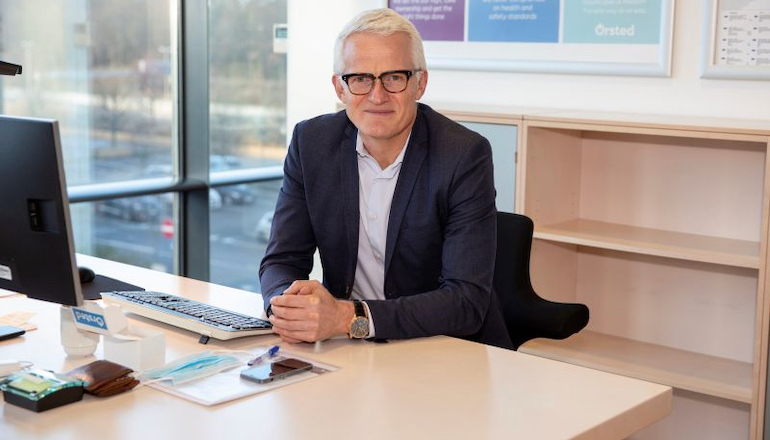
Orsted chief executive Mads Nipper (pictured) said the developer is still keenly interested in building in-house experience with floating wind, which it regards as a commercial opportunity for the 2030s.
“We can absolutely get into floating without acquiring another player active in that field. We have deep skills in our development teams and can also partner up with other floating developers to gain experience,” he said.
Nipper believes Orsted will firm up the extra capacity needed to hit the new target from its opportunity pipeline, despite increased competition from oil and gas developers looking to get into offshore wind.
“We are very confident. The pond we are fishing in is so large that we can even be selective with the projects we are chasing,” he said.
The developer has mature opportunities worth some 14GW in its crosshairs across Europe the US and Asia Pacific and Nipper believes it can secure “the vast majority” of those.
Nipper said Orsted is unfazed by plans from rival companies to develop even larger renewables portfolios over the next decade.
Enel of Italy is targeting 120GW by the end of the decade, while Spain’s Iberdorla has set out its stall for 95GW of clean power capacity in the same period.
“We don’t want to be the biggest just in terms of capacity, it’s not about how many ‘bragawatts’ you can install,” Nipper said.
“We want to be the most sustainable company that is also the most effective deployer of capital.”
Orsted plans to invest Dkr350bn (€47bn) in green energy from 2020 to 2027 and believes it can support an average return on capital employed in this period of 11-12%.
The developer has also committed to ban the landfilling of old turbine blades and pledged to achieve a carbon neutral footprint by 2040 and ensure all projects built from 2030 have a net positive biodiversity impact.
Orsted is meanwhile tracking opportunities in Asia Pacific as it looks to grow its installed onshore wind capacity from 2.4GW today to 17.5GW in 2030.
“Around 80% of investments in the period will be in the US, but I would not rule out investments in Asia Pacific,” Onshore chief executive Declan Flanagan explained.
The company is also looking at onshore opportunities in Europe.