


Lloyd’s Register (LR) has granted approval in principle for Spanish company Seaplace’s active ballast control system, designed for the company’s Crown floating offshore wind platform concept.
Crown includes both buoy and reduced-draft spar operational concepts, which the company said are expected to reduce CAPEX costs.
The active ballast control system is used to ballast/de-ballast the unit, changing the floater from its transport draft to its operational draft and vice versa.
Seaplace said the system can also be used to partially or fully compensate the mean tilt produced by the wind loads improving the stability of floating offshore wind platforms.
The system was reviewed against applicable Rules and Regulations for the Classification of Offshore Units, including the acceptance of preliminary Failure Modes Effects and Criticality Analysis of the system.
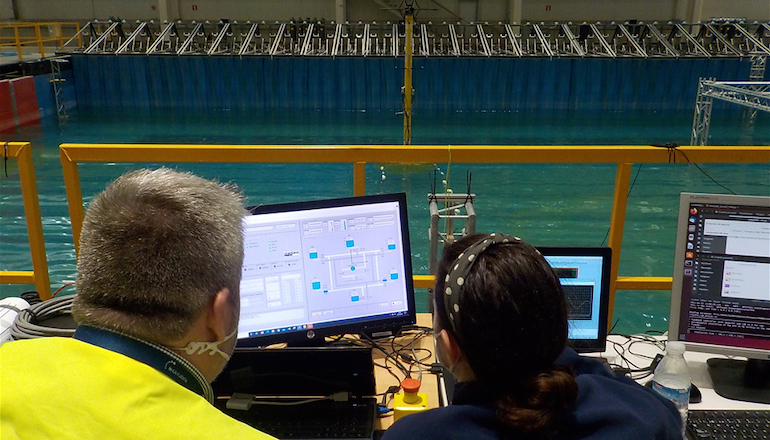
Seaplace said the system, which has been designed to be used with different types of floating wind platforms, was first tested with software-in-the-loop tests and then with scale model tests performed at the IH Cantabria Offshore basin, as part of the Crown project.
LR marine and offshore director Mark Darley said: “Lloyd’s Register is proud to have supported Seaplace in the final phase of the Crown technology development, enabling the company to move onto the full-size demonstration concept stage.
“This novel technology could help operators and their floating wind assets reach their market potential, with estimates of up to 10GW of capacity projected to be installed globally by 2030 and more than 100GW by 2050.”