


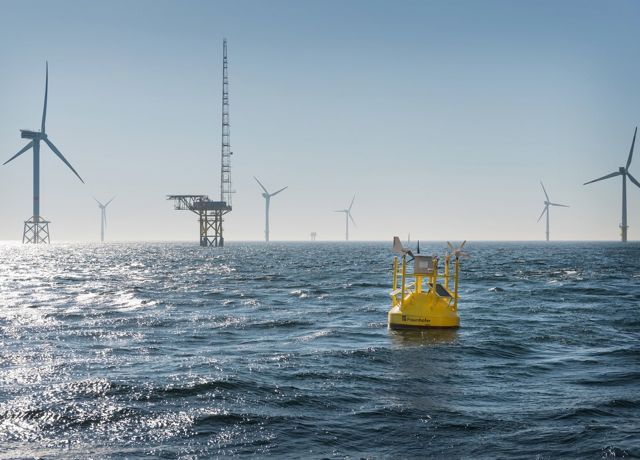
Fraunhofer IWES is conducting a boulder detection and geohazard survey of 50 wind turbine locations and the associated OSS for Iberdrola’s Baltic Eagle wind farm off the German coast.
A three-week measurement campaign in the Baltic Sea took place back in October and November 2020, using the novel proprietary Manta Ray G1 system developed by Fraunhofer IWES for data recording.
The acquired data is currently being interpreted at the institute with the goal of completing the project by the end of April 2021.
Iberdrola and Baltic Eagle were awarded the rights to construct the 476MW offshore wind farm in the Baltic Sea in 2018.
The site is located northeast of the German island of Rügen in the direct vicinity of existing and planned offshore wind farms.
Baltic Eagle ground engineering manager Kevin O’Reilly said: “We are happy to be working with Fraunhofer IWES on boulder detection to minimise the risks involved in installing large diameter monopiles in challenging ground conditions.”
When constructing offshore wind turbines, boulders and other geological features (shallow gas accumulations, cohesive strata) may pose a risk to the erection of the wind turbines.
In particular, boulders in the sediment can cause damage to the driven piles during installation of the support structures.
Potential termination of installation and extended delays can result in high costs for wind farm developers.
Accurate knowledge of the sub-seafloor geology (for example, the position of boulders in the sub-seafloor) allows for efficient, small-scale micro-siting of the foundations, thus minimizing the installation risks.
The Manta Ray G1 is a novel data acquisition system developed by Fraunhofer IWES and the University of Bremen specifically for the purpose of diffraction imaging and the localization of point diffractors within marine sediments.
Diffraction refers to the deflection of waves by an obstacle.
In addition to the diffraction data, conventional 3D seismic reflection data are acquired along the profile lines.
The system operates on the principle that objects within the seafloor act as point diffractors when illuminated by a signal source.
The recording of the resulting acoustic diffractions and accurate processing of the diffracted energy allow localization of the original diffraction, i.e. the boulder in the sediment.
The specially designed acquisition geometry of the Manta Ray G1, together with synthetic aperture processing, allows blanket coverage of the survey area, resulting in excellent overall data coverage as well as time- and cost-efficient survey operations.
Fraunhofer IWES head of department sub-surface investigations Dr Benedict Preu said: “Fraunhofer IWES is supporting Iberdrola in de-risking the monopile foundations planned in Baltic Eagle by deploying its proprietary boulder imaging technology.
“Tasks like these showcase our ability to provide tailored solutions for the challenges posed by offshore site investigation.
“As such, we are making a major contribution to supporting the wind energy industry to overcome the limitations of state of the art technology.”