


RWE is to deploy collared monopiles at its 342MW Kaskasi offshore wind farm in what it says is an industry first.
The developer has signed a contract with DEME Offshore for the transport and installation of the new foundation technology with offshore construction works expected to start in Q3 2020 at the wind farm located in the German North Sea, 35 kilometres north of the island of Heligoland.
Special collars will be installed around three monopile foundations at seabed level, based on an RWE-patented technology, to provide additional support for lateral loading, increase the bearing capacity and improve the structural integrity of the entire foundation, especially in difficult ground.
Detailed design of the collars was developed by the German civil engineering company JBO based on the RWE patent, with Bladt Industries selected as manufacturer.
In total 38 monopiles will be installed at the site, which will feature up-to-9MW turbines, with a “vibro pile driving” installation method used instead of hammering monopiles into the seabed which RWE says could reduce installation time and noise emissions during construction.
RWE Renewables chief operating officer wind offshore global Sven Utermöhlen said: “The collared monopile, a patented solution developed in-house, will help to increase stability in difficult ground.
“Furthermore, Kaskasi will be the first commercial offshore wind farm in the world to use an improved installation method to drive all monopile foundations to target penetration.
“The vibro pile driving technique will reduce both installation time as well as noise emissions for marine life.
“This showcases our technical expertise as the second biggest player in offshore wind globally and means that we will continue to be at the forefront of the evolution of technology in this industry.”
DEME Offshore business unit director northern Europe Bas Nekeman added: “The Kaskasi collar installation project is a good example of how we can bring added value to our clients.”
The project is due online in summer 2022.
DEME Offshore will transport the three collars from the manufacturer’s load-out port in Aalborg, Denmark, to the Kaskasi construction site near Heligoland.
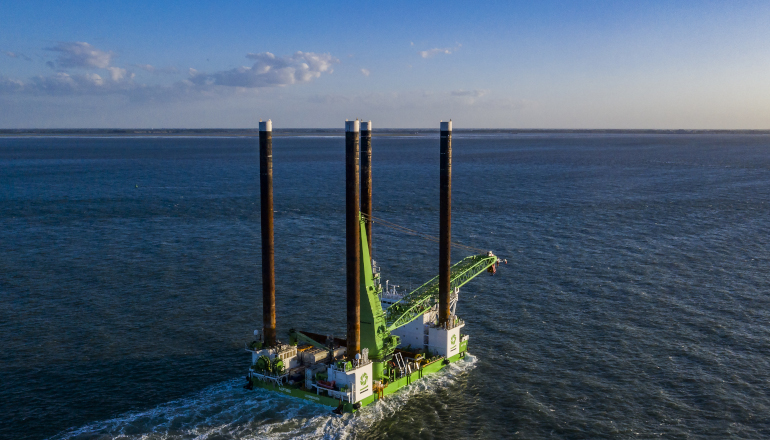
Then the DEME Offshore team will install the steel collars around three of the 38 monopile foundations for which DEME Offshore will deploy the versatile jack-up vessel ‘Neptune’.
The collar will be installed at seabed level in water depths of up to 25 metres.
The space between collar and monopile foundation will be filled with grout material to create a stable connection, the company added.
RWE will carry out accompanying tests to verify that the collar improves the structural behaviour in comparison to standard monopiles.