


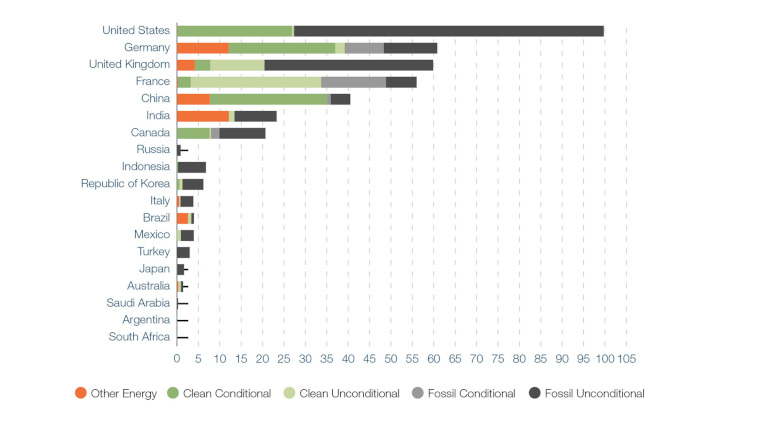
A new report from global technology company Wärtsilä shows that the bulk of UK and US stimulus packages announced for energy have supported fossil fuel generation.
The company said the measures to rebuild from the impact of the COVID-19 pandemic were missing the opportunity to create new green jobs and accelerate the transition towards a flexible, renewable-powered economy.
Wärtsilä’s report – Aligning Stimulus with Energy Transformation – highlights that $5 billion (£3.8 billion) stimulus commitments have been allocated to support fossil fuel energy (shown in black or grey in the chart above) compared to only $158 million (£121 million) for clean power generation.
It pointed out this was not aligned with the UK’s ambitious targets to achieve 57% greenhouse gas reduction by 2030 compared with 1990 levels and net-zero by 2050.
The report models what could be achieved if UK energy stimulus was entirely dedicated to measures to cost-optimally increase renewable energy, aligning economic recovery with decarbonisation.
Wärtsilä’s analysis identifies that UK energy stimulus, leveraged to unlock private sector investment towards the energy transition, could enable the UK to reach a 60% renewable power system by 2025.
This would cut power sector carbon emissions by 58% compared to current levels and put the UK on track to meet its net-zero emissions target by 2050.
A cost-optimal 60% renewable power system would consist of 60GW existing and new renewable energy, supported by significant investment in energy storage and new flexible gas-based technologies, capable of operating on bio- and renewable synthetic fuels, including 7GW of battery energy storage and 14GW of flexible gas-based generation enabled for future carbon-neutral fuels, the company claimed.
This could result in over 120,000 jobs in the renewable energy sector alone – 175% more than focusing stimulus on rebuilding legacy energy systems.
Wärtsilä Energy growth and development director Ville Rimali said: “In the UK and across the G20 as a whole, the stimulus ‘scales’ are too weighted towards support for legacy fossil fuel-powered systems, despite the agenda for rapid decarbonisation that’s underway worldwide.
“Refocusing stimulus towards renewable and flexible energy would accelerate this shift, create jobs and cut emissions.
“The UK energy system is at a fork in the road. The current road could lock-in unnecessary fossil fuels, create 60% fewer jobs and miss the UK’s net-zero target.
“The alternative road leverages economic stimulus to unlock massive private sector investment, clearly putting the UK on a net-zero trajectory – potentially achieving a 60% share of renewables by 2025 and cutting emissions intensity by 58%.
“The UK has enormous potential to accelerate to net-zero and present a blueprint for other countries to follow, stimulating investment, jobs, technology intellectual power and economic growth.”
Wärtsilä’s report also modelled scenarios where the United States focuses its current stimulus package for energy on measures that cost-optimally increase renewable energy.
In the US, if all of the current stimulus pledged to support legacy fossil fuel sectors ($72 billion USD) was allocated to advance the energy transition towards renewable, flexible power systems, over 100GW of new renewable energy capacity could be achieved.
This could result in over 500,000 new jobs in renewable energy – 175% more new than if stimulus was focused on legacy, inflexible fossil fuel energy.
To assess the full impacts and technology needs of the cost-optimal transformation to renewable energy systems, Wärtsilä modelled a scenario for a carbon-neutral electricity sector for the US by 2035.
The model demonstrates that a cost-optimal, carbon-neutral power system could be achieved with 1,700GW of new wind and solar, supported by battery energy storage and flexible gas-fired power capacity operating on renewable bio- or synthetic fuels. The fully renewable power system could create 8.7 million jobs in renewable energy alone, and have an expected investment value of $1.7 trillion USD.
To ensure reliability of a renewable-powered electricity system, the Wärtsilä report reveals that over 400GW of battery energy storage capacity and over 100GW of flexible gas power capacity, running on renewable synthetic fuels, would be needed.
Over 150GW of electrolyser capacity for Power-to-X processes would be required for the production of synthetic fuels.
Technologies for replacing costly, inflexible thermal generation capacity exist today and Wärtsilä’s analysis argues that Power-to-X processes – which produce carbon neutral, renewable synthetic fuels by capturing CO2 emissions and synthesising with renewable hydrogen – will be a key component for providing flexibility and stability for renewable power systems.
The report also looked at G20 governments, which it said had so far committed at least $145 billion towards supporting clean energy, as part of economic stimulus measures.
However, this is a third less than the $216 billion that has been committed to supporting fossil fuel energy.
The report is available to download from www.wartsila.com/energy.