


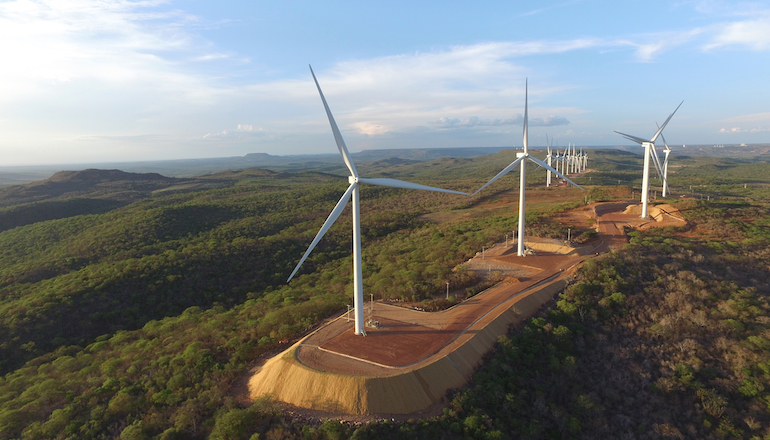
Capacity from “super-competitive” wind and solar power will contribute to a steady fall in emissions in energy generation from 2027, according to BloombergNEF’s (BNEF) New Energy Outlook (NEO) 2020.
BNEF’s latest projection shows that from 2027 energy emissions fall at a rate of 0.7% per year to 2050.
This prospect is based on uptake of electric vehicles and improved energy efficiency across industries, in addition to “huge buildout of ‘super-competitive’ wind and solar power”.
Wind and solar combined will account for 56% of global electricity generation by mid-century and together with batteries take 80% of the $15.1trn invested in new power capacity over the next 30 years, the analysis found.
An additional $14 trillion is invested in the grid to 2050.
BNEF’s latest analysis found the drop in energy demand due to the coronavirus pandemic will remove some two and a half years’ worth of energy sector emissions between now and 2050.
In 2020 the Covid-19 pandemic led to a 10% reduction.
While BNEF forecasts the economic recovery will lead to an increase, emissions from fuel combustion in the energy sector will “never again” reach 2019 levels.
The latest NEO found coal-fired power peaks in China in 2027 and India in 2030, collapsing to 12% of global electricity generation in 2050.
In contrast, gas is the only fossil fuel to keep growing throughout the outlook, up 0.5% year-on-year to 2050, growing 33% in buildings and 23% in industry where there are few economic low-carbon substitutes.
Despite the progress of the energy transition, and the decrease in energy demand brought by Covid-19, BNEF has modelled that energy sector emissions will put the world on course for a 3.3 degrees Celsius temperature increase by 2100.
BNEF CEO Jon Moore said: “The next 10 years will be crucial for the energy transition.
“There are three key things that we will need to see: accelerated deployment of wind and PV; faster consumer uptake in electric vehicles, small-scale renewables, and low-carbon heating technology, such as heat pumps; and scaled-up development and deployment of zero-carbon fuels.”
Whereas NEO previously focused on the electricity sector, this year’s report includes detailed chapters on industry, buildings and transport to give a full-coverage, economics-led view of the energy economy to 2050.
The report also features a “climate scenario” investigating a clean electricity and hydrogen pathway to holding temperatures to well below 2 degrees.
BNEF chief economist and the NEO 2020 lead author Seb Henbest said: “Our projections for the power system have become even more bullish for renewables than in previous years, based purely on cost dynamics.
“What this year’s study highlights is the tremendous opportunity for low-carbon power to help decarbonise transport, buildings and industry – both through direct electrification and via green hydrogen.”
BNEF said a clean electricity and green hydrogen pathway requires between $78trn and $130trn of new investment between now and 2050 to cover growth in electricity generation and the power grid, as well as manufacturing, storing and transporting hydrogen.