


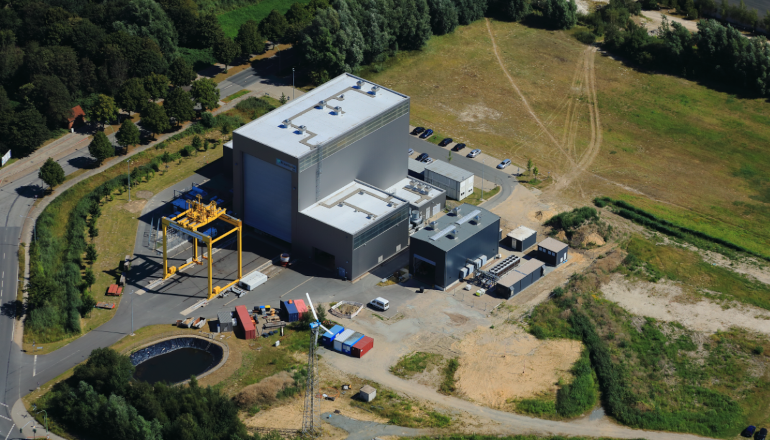
The Fraunhofer Institute for Wind Energy Systems (IWES) is investing €30m to expand a testing facility for wind turbine generators and converters.
A first phase of expansion is seeing it put into operation a new test bench in Bremerhaven, part of a partnership between the city, the Federal Ministry for Economic Affairs and Energy (BMWi), and manufacturers Vestas and Nordex.
Future plans will see a newly erected hall where converter and generator systems for multi-megawatt wind turbines will be tested for grid compatibility.
The institute said grid operators’ standards were likely to increase in future and that the costs and time of verification tests could be cut using test benches for reproducible laboratory conditions, independent of wind conditions.
It added that an increased degree of technical flexibility on the test bench could create more comprehensive and future-proof testing options and that in the past, the electrical characteristics of new wind turbines could only be tested in the field.
The Hil-GridCoP project – short for “Hardware-in-the-loop testing of the electrical grid compliance of multi-megawatt wind turbines with high-speed generator systems” – uses a testing method developed to allow electrical certification in the laboratory on a minimal system, without the entire wind turbine.
The Fraunhofer IWES said that automated testing and significantly lower logistical efforts could reduce manufacturer reduced and create shorter and more predictable times to market.
“This new test method represents a rapid and cost-efficient means of performing the tests to verify the electrical characteristics of wind turbines,” said Vestas Nacelles Deutschland GmbH chief specialist test and validation Christian Fenselau.
Nordex Energy GmbH electrical engineering director Dr Christian Wessels said the test bench-based verification of the electrical grid characteristics of wind turbines was “key if wind turbine manufacturers are to be able to satisfy the growing market demands on shorter development times and higher model variety”.
He added: “We hope that the project will make a significant contribution to the acceptance of test bench results by certification guidelines”.
The Hil-GridCoP project is being funded by the BMWi to the tune of €8.9 million in total.
New construction work and the connections to the existing infrastructure of the Dynamic Nacelle Testing Laboratory (DyNaLab) were financed through a combination of the Fraunhofer IWES’s own funds and funds of the Fraunhofer society.
“In future, innovations in wind energy technology will remain a necessary prerequisite for the success of the energy transition,” said BMWi Wind Energy Research Projects funding officer Timo Haase.
“To this end, both high-quality standards and reliability are rightly essential. The use of test benches to confirm these characteristics can shorten the testing periods significantly and thus facilitate considerably shorter innovation cycles.”
The Institute’s testing infrastructure will also be used for testing other power generation systems in future such as hydrogen production, photovoltaic technology, and energy storage technology.
The Fraunhofer IWES is also implementing further projects at the site in Bremerhaven with the aim of improving the performance and grid compatibility of wind turbines.
With the Mobile Test Facility for Grid Compliance Tests – Mobil-Grid-CoP project – the Fraunhofer IWES is developing the world’s largest grid simulator with an output of 80 megavolt-amperes (MVA).
This can be integrated seamlessly into the DyNaLab’s existing test infrastructure on the one hand and can also be used directly by partners and customers to test systems of up to 66 kV on the other.
Furthermore, connection to a planned hydrogen test field is also possible, with BMWi funding to the tune of €12.7 million, expected to be launched in 2022.