


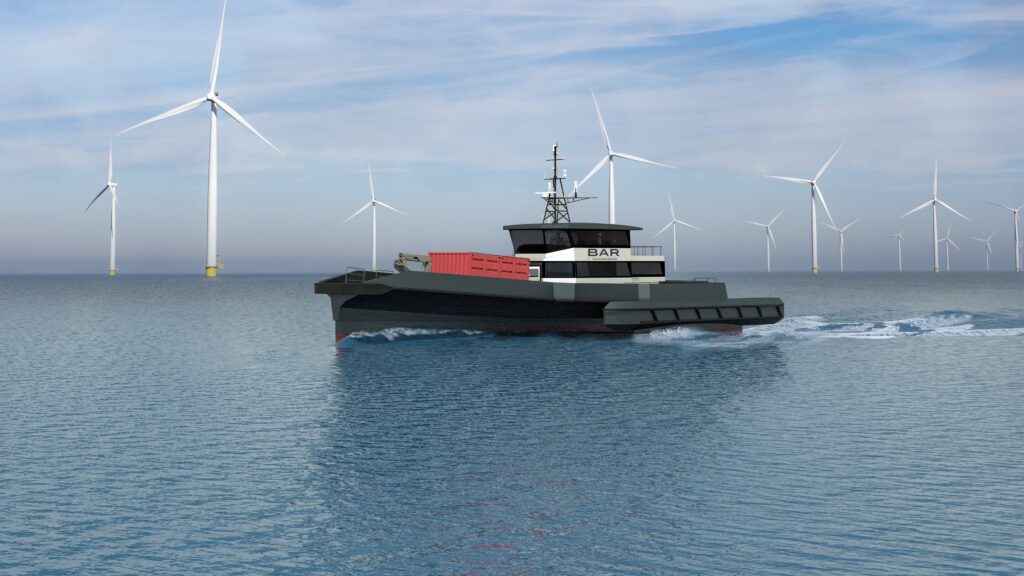
Chartwell Marine and naval architect outfit Bar Technologies have secured approval in principle (AiP) from the American Bureau of Shipping (ABS) for a crew transfer vessel (CTV) for offshore wind deployments in the US.
The AiP is a “key milestone” towards a class-certified, Jones Act-compliant fleet of offshore wind support vessels for the US market.
Bar, with the support of Chartwell, has developed a 30 metre-long CTV, making use of foil optimised stability system (FOSS) technology to enhance seakeeping and manoeuvrability, while reducing vertical acceleration by up to 70% in 2.5 metre-high wave heights.
The CTV can also achieve up to 50% fuel efficiency savings at 15 knots, to meet US standards, Bar said.
This initial vessel will be followed by a 50 metre-long variant capable of 45 knots top speed and 30 knots in a 3 metre-high sea without exceeding vertical acceleration limits.
The 40-passenger boat with a similar hull form and FOSS technology can potentially replace helicopter transfer for workers in the Gulf of Mexico.
This new design will work in partnership with the vessels in the Chartwell 24 range, including the Right Whale variant.
As part of the AiP process, the vessel designs meet criteria from the ABS Rules for Building and Classing High Speed Craft 2020. This provides validation that they are well-placed to meet the demands and regulatory requirements of US operations, said Chartwell.
Chartwell Marine managing director Andy Page said: “This ‘rubber stamp’ from ABS paves the way for these next generation vessels to fully integrate into East Coast operations.
“The design of these boats has capitalised on operational experience in the global market, refining the formula for offshore wind support through ongoing research and discussion with stakeholders.”
“With the first Chartwell 24 working in the UK and the first US Chartwell 24 in build, we are excited to work with Bar to bring a further, highly versatile option to the US market.”