


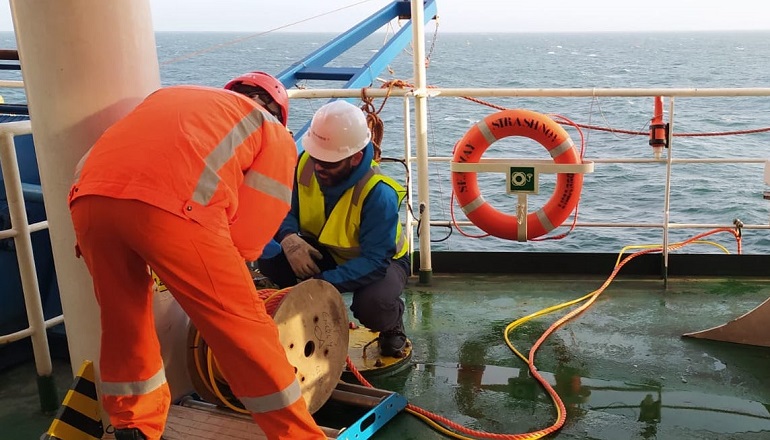
Seiche Environmental is providing mitigation measures for seals and other marine mammals at the 857MW Triton Knoll offshore wind project being built off the eastern England seaboard.
Seiche will ensure that the impact of underwater noise from construction activities to install the 90 monopile foundations for the turbines and two substations has minimal impact on any local cetaceans and seals.
The company’s marine mammal mitigation team is based on-board the 183 metre-long installation vessel Seaway Strashnov.
The team is using passive acoustic measurement (PAM) equipment to identify if any marine mammals are present under water.
An acoustic deterrent device – Lofitech’s ‘Seal Scarer’ – is used to help keep any marine mammals that may be present, beyond the 500 metre radius protection zone, established before live piling operations.
Seiche’s team of observers and PAM operators ensure that the Marine Mammal Mitigation Protocol, which follows the government’s Joint Nature Conservation Committee’s guidance protocol, is adhered to at all times.
The company is also recording and reporting on noise output during the installation of the initial piles, so that predictions that are used to assess the potential impact on marine fauna can be validated.
Seiche Environmental associate director Nicola Harris said: “Understanding and minimising the impact of offshore construction on marine mammals is a vital part of modern offshore wind farm development.
“Pile driving activities are governed by strict marine mitigation procedures, and we are proud to be providing the crucial expertise to ensure that the noise from these works is managed in a way that is not damaging to the like of grey seal, harbour porpoise and harbour seal, as well as other species less common in the North Sea, including white-beaked dolphin and minke whale.”
The project covers the Triton Knoll turbine array, which is spread over 145 square kilometres, an area bigger than the city of Manchester.
Innogy, which owns the project, with J-Power and Kansai Electric Power, is responsible for managing the wind farm’s construction, long-term operation and maintenance works.