


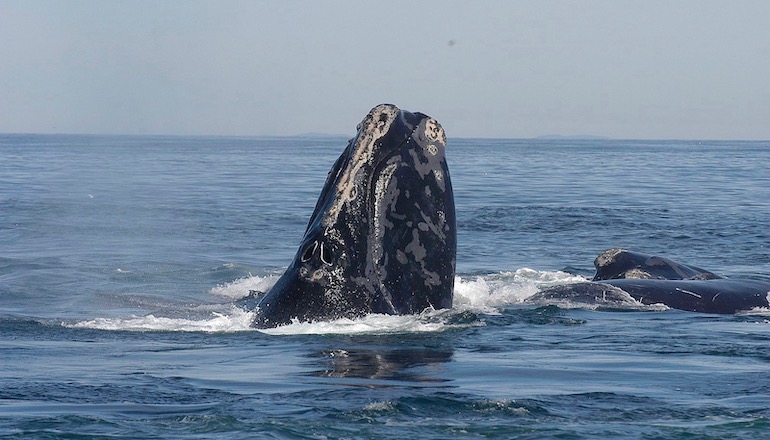
Orsted US Offshore Wind is partnering with several universities and research institutions on a project to advance technology to protect and conserve Right Whales.
The developer is working with Rutgers, The State University of New Jersey, the University of Rhode Island and Woods Hole Oceanographic Institution on the Ecosystem and Passive Acoustic Monitoring (ECO-PAM) project.
Orsted signed an initial memorandum of understanding with Rutgers University in May 2019 to support academic research activities related to offshore wind.
The ECO-PAM project will be in addition to this initial funding agreement.
The company plans to apply the project’s learnings to develop tailored processes and procedures to better protect the North Atlantic Right Whale during survey, construction and operation phases of their US offshore wind farm portfolio.
The goal of the three-year partnership is to better understand the habitat as well as the presence, distribution and seasonality of the endangered species within Orsted lease areas.
A secondary benefit will be to enable coastal communities to utilise the oceanographic data gathered to help with weather forecasting and predicting severe storms.
ECO-PAM will rely on data collected from two, near real-time sound detection buoys deployed by Woods Hole and one experimental buoy deployed by the University of Rhode Island.
Those two institutions will take the lead on advancing localisation and detection distance methods for fixed buoy systems.
The project will also feature the use of an unmanned glider that will be led by Rutgers to telemeter to shore in near real-time oceanographic data and detections of marine mammal vocalisations.
Acoustic receivers on the glider and buoys will also collect data that will be shared with networks, such as the Mid-Atlantic Acoustic Telemetry Observation System, which was established to monitor for fish tagged by multiple researchers in the region.
Data collected by the receivers will contribute to furthering the understanding of movement patterns of a range of species included those of importance to the fishing industry, Orsted said.
Orsted head of US permitting Sophie Hartfield said: “This unique project unites business and academia, allowing some of the greatest minds to work together to study and deploy new, advanced technology that will enable us to work toward the goal of helping to protect and conserve the right whale.
“It is imperative that Orsted take a leadership role in this given our offshore presence along the eastern coastline.”
University of Rhode Island professor of ocean engineering and oceanography James Miller said: “The technology exists now to acoustically detect and track marine mammals such as the North Atlantic right whale with fixed and mobile systems and this project will demonstrate this technology.”
Rutgers University Center for Ocean Observing Leadership director of atmospheric research Joseph Brodie said: “The environmental variables collected on these glider missions will be fed directly into national data systems that provide vital ocean information for improving the prediction of marine-driven weather, such as coastal storms.”
Woods Hole Oceanographic Institution senior scientist Mark Baumgartner said: “Our project will help to minimize the impact of wind farm construction and operation on whales so that both we and the whales can reap the long-term benefits of clean energy.”